DAT Fundamentals: Biology & Chemistry Essentials
Master foundational concepts in biology, general chemistry, organic chemistry, and perceptual ability for DAT success.
SPACED REPETITION · 27 practice questions
Make this lesson stick.
Answer questions, get feedback, and build your review pool. Correct answers move toward longer review intervals; missed answers return sooner.
Sign in to practice →DAT Fundamentals: Biology & Chemistry Essentials
Revision note (July 2026): Updated for the DAT's 200–600 scoring scale (in force since 1 March 2025), corrected the description of the exam's four sections, and stated plainly which sections this course does and does not cover. Tables and diagrams were stored as raw HTML and displayed as literal markup on the lesson pages; they are now rendered properly. A later pass corrected factual errors flagged in place below, and added the DAT's "painted on all exposed sides except the bottom" cube-counting rule.
Prepare for the Dental Admission Test with free flashcards covering the Survey of Natural Sciences and the Perceptual Ability Test. This lesson introduces biology (the highest-yield subject, with 40 of the 100 science questions), general chemistry, organic chemistry, and perceptual ability. You'll learn strategic approaches to the 90-minute science section while building a foundation in the most tested concepts.
Welcome to DAT Preparation! 🦷
The DAT is a comprehensive exam that assesses your readiness for dental school across multiple disciplines. It requires you to switch rapidly between biology, chemistry, spatial reasoning, reading and maths — all under tight time limits. This lesson focuses on high-yield concepts that appear most frequently, along with test-taking strategies.
📋 First: what the exam actually looks like
The DAT has four scored sections, 280 questions in total, taking roughly 5 hours 15 minutes including the optional tutorial and breaks. Biology, General Chemistry and Organic Chemistry are not separate sections — they are the three subjects inside the first one:
| Section | Questions | Time | Notes |
|---|---|---|---|
| Survey of Natural Sciences | 100 | 90 min | Biology 40, General Chemistry 30, Organic Chemistry 30 — about 54 s per question |
| Perceptual Ability Test (PAT) | 90 | 60 min | Six question types — about 40 s per question |
| Reading Comprehension | 50 | 60 min | Three science passages |
| Quantitative Reasoning | 40 | 45 min | The only section with an on-screen calculator |
⚠️ What this course covers. These five lessons cover the Survey of Natural Sciences and the PAT — 190 of the 280 questions. Reading Comprehension and Quantitative Reasoning are not covered here, and together they are 90 questions, roughly a third of the exam. Do not treat this course as a complete DAT syllabus; plan separate preparation for those two sections.
🔢 Scoring — the scale changed in 2025
Since 1 March 2025 the DAT is reported on a 200–600 scale in 10-point increments (200, 210, … 600). This replaced the old 1–30 scale, so advice framed as "aim for a 20" or "22+ scorers" refers to the retired system. Scores earned before that date are converted using the ADA's concordance tables. Unofficial results are no longer shown at the test centre. The content and structure of the exam did not change — only the reporting.
💡 When you read older forum posts or prep books, mentally translate any 1–30 figure; do not mix the two scales when setting a target.
What Makes the DAT Unique:
- 🧬 Biology dominance: 40 out of 100 science questions
- ⏱️ Time pressure: 90 minutes for all 100 science questions — about 54 seconds each
- 🧪 Breadth over depth: Tests wide knowledge rather than advanced theory
- 🔺 Perceptual Ability: Unique spatial reasoning section not found on most exams
💡 Pro Tip: The DAT rewards breadth of knowledge over deep specialization. Focus on understanding core concepts across all topics rather than mastering any single area.
Core Concepts: Biology (Highest Yield!) 🧬
Biology is 40 of the 100 questions in the Survey of Natural Sciences — the largest single subject, and the one with the widest content range. Note that Biology, General Chemistry and Organic Chemistry each receive their own reported score in addition to the combined Total Science score. Focus on these high-yield areas:
Cell Biology & Molecular Biology
Cell Membrane Structure - The foundation of cellular function:
- Phospholipid bilayer: Hydrophilic heads face outward, hydrophobic tails face inward
- Fluid mosaic model: Proteins float within the membrane like icebergs in a sea
- Selective permeability: Controls what enters and exits the cell
Key Transport Mechanisms:
| Transport Type | Energy Required? | Direction | Example |
|---|---|---|---|
| Simple Diffusion | No (passive) | High → Low concentration | O₂, CO₂ across membrane |
| Facilitated Diffusion | No (passive) | High → Low concentration | Glucose through protein channels |
| Active Transport | Yes (ATP) | Low → High concentration | Na⁺/K⁺ pump |
| Osmosis | No (passive) | Water moves to high solute | Water entering cells |
🧠 Mnemonic for Active Transport: "Active needs ATP" - if it's moving against the gradient, it needs energy!
Organelles and Their Functions:
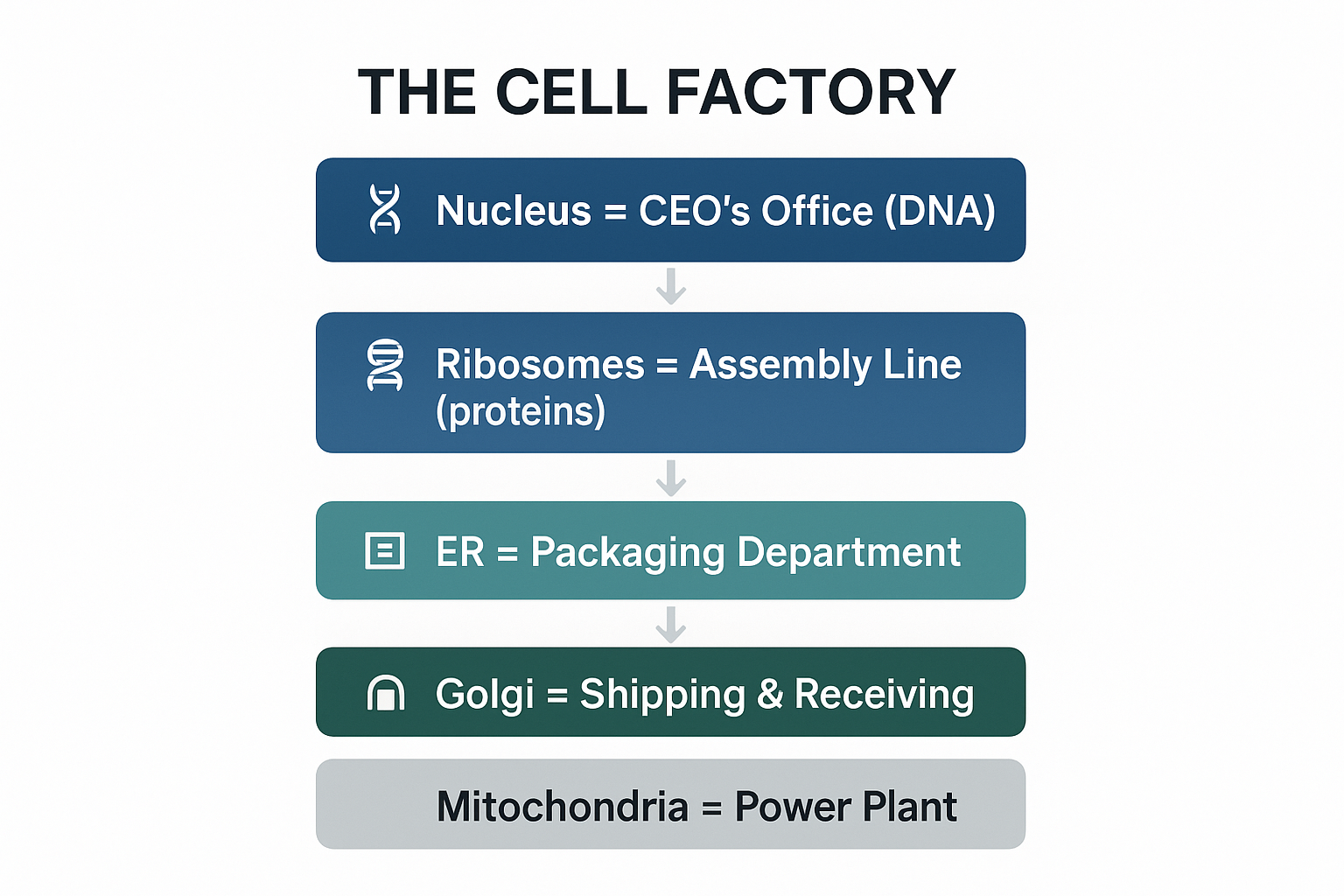
THE CELL FACTORY
┌─────────────────────────────────────────┐
│  🧬 Nucleus = CEO's Office (DNA)       │
│     │                                   │
│     ↓                                   │
│  📜 Ribosomes = Assembly Line (proteins)│
│     │                                   │
│     ↓                                   │
│  📦 ER = Packaging Department           │
│     │                                   │
│     ↓                                   │
│  🏤 Golgi = Shipping & Receiving        │
│     │                                   │
│     ↓                                   │
│  ⚡ Mitochondria = Power Plant (ATP)    │
└─────────────────────────────────────────┘
Genetics & DNA
DNA Replication - "Semi-conservative" means each new DNA molecule contains one old strand and one new strand:
- Helicase unzips the double helix (think: helicopter blades spinning)
- Primase lays down RNA primers (starting points)
- DNA polymerase adds nucleotides in the 5' → 3' direction
- Ligase seals gaps between Okazaki fragments on the lagging strand
🧠 Mnemonic for DNA Replication Enzymes: "Help Please Dear Lucy"
- Helicase, Primase, DNA polymerase, Ligase
Protein Synthesis Flow:
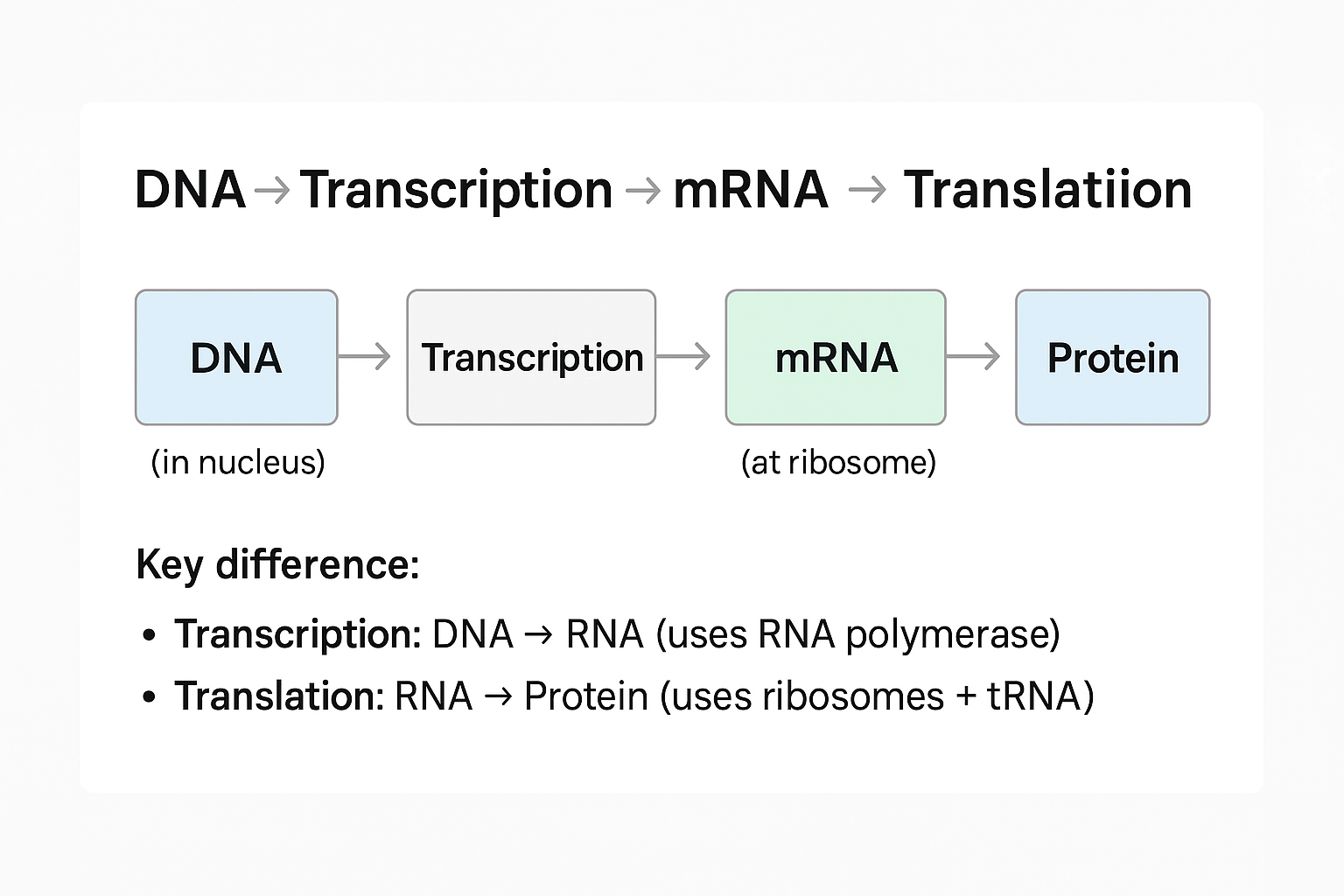
DNA → Transcription → mRNA → Translation → Protein
🧬      (in nucleus)    📜    (at ribosome)    🔧

Key difference:
• Transcription: DNA → RNA (uses RNA polymerase)
• Translation: RNA → Protein (uses ribosomes + tRNA)
Codon Chart Essentials:
- Start codon: AUG (codes for methionine)
- Stop codons: UAA, UAG, UGA
- 🧠 Mnemonic for Stop Codons: "U Are Away, U Are Gone, U Go Away"
Evolution & Ecology
Natural Selection - Darwin's four key principles:
📋 Natural Selection Checklist
| Principle | What it means |
|---|---|
| 1. Variation | Individuals in a population differ |
| 2. Inheritance | Traits are passed to offspring |
| 3. Overproduction | More offspring than can survive |
| 4. Differential Survival | Best-adapted individuals survive and reproduce |
Population Ecology Terms:
- Carrying capacity (K): Maximum population size an environment can sustain
- Limiting factors: Resources that restrict population growth (food, water, space)
- Exponential growth: J-shaped curve (unlimited resources)
- Logistic growth: S-shaped curve (limited resources, levels off at K)
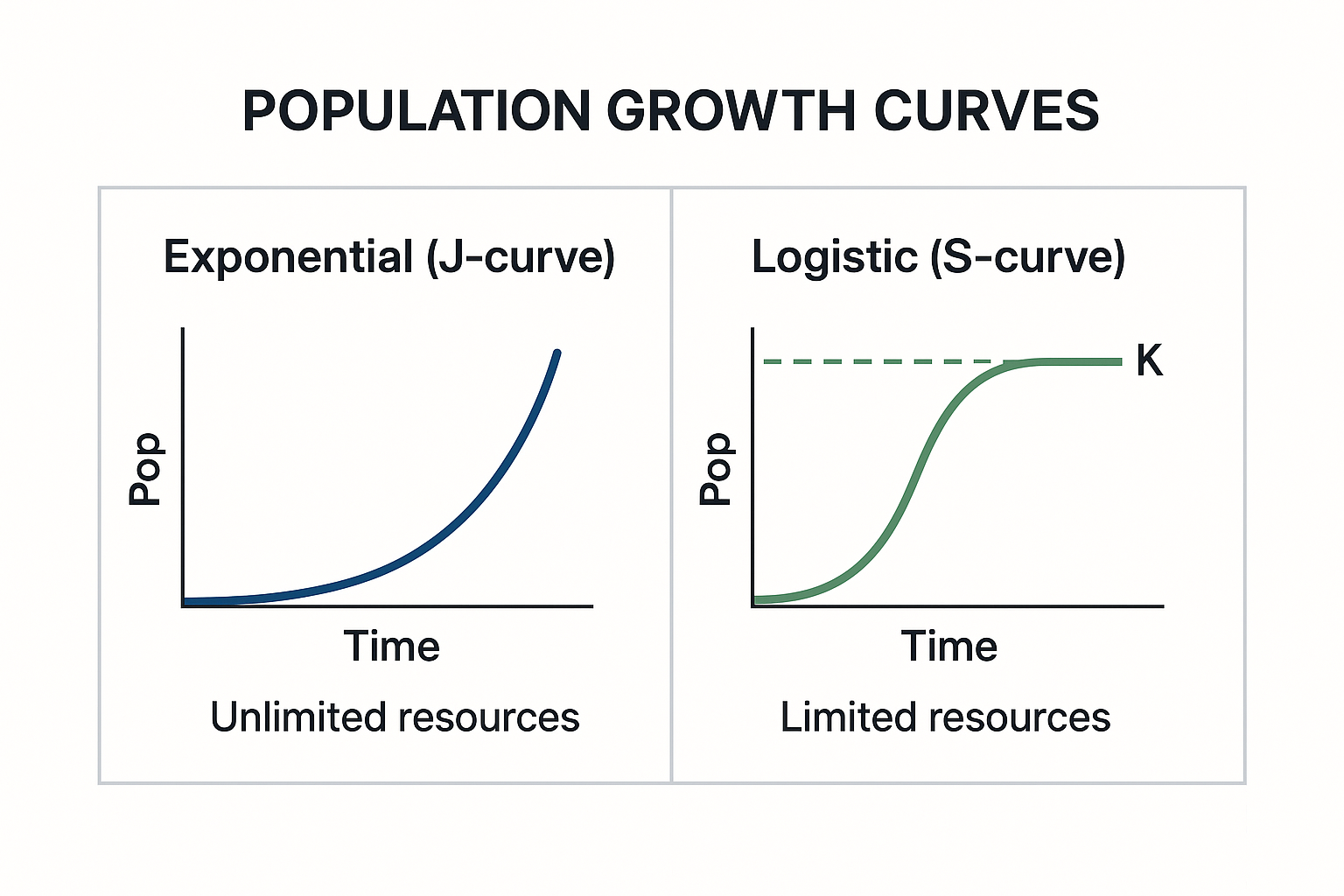
POPULATION GROWTH CURVES

Exponential (J-curve)     Logistic (S-curve)
    │                         │     ___K___
    │        ╭                │   ╱
Pop │      ╱                  │  │
    │    ╱                    │ ╱
    │  ╱                      │╱
    └─────── Time            └────── Time
   Unlimited resources      Limited resources
Core Concepts: General Chemistry 🧪
Atomic Structure & Periodic Trends
Periodic Table Trends - Master these for quick problem-solving:
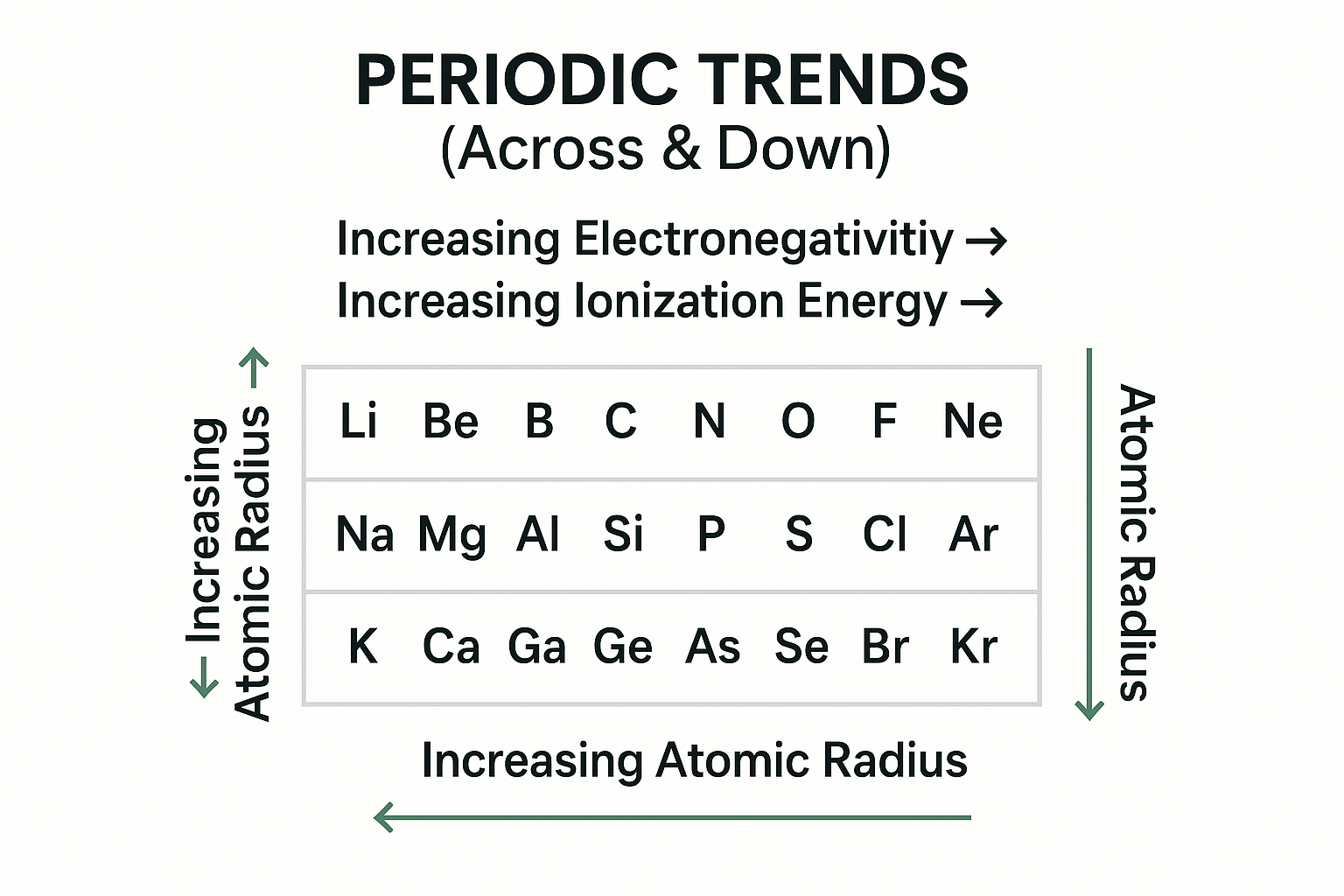
PERIODIC TRENDS (Across & Down)

        → Increasing Electronegativity →
        → Increasing Ionization Energy →
        ← Increasing Atomic Radius ←
┌──────────────────────────────────────┐
│ Li   Be   B    C    N    O    F   Ne│ ↑
│                                      │ │
│ Na   Mg   Al   Si   P    S   Cl  Ar │ │ Increasing
│                                      │ │ Atomic
│ K    Ca   Ga   Ge   As  Se   Br  Kr │ │ Radius
└──────────────────────────────────────┘ ↓
💡 Test Strategy: Questions often ask you to compare element properties. Remember: Francium is the largest atom, Fluorine is the most electronegative (opposite ends!).
Quantum Numbers - Describe electron location:
| Symbol | Name | Describes | Values |
|---|---|---|---|
| n | Principal | Energy level/shell | 1, 2, 3, 4... |
| l | Angular momentum | Subshell shape | 0 to (n-1) 0=s, 1=p, 2=d, 3=f |
| mₗ | Magnetic | Orbital orientation | -l to +l |
| mₛ | Spin | Electron spin | +½ or -½ |
Stoichiometry & Chemical Reactions
Mole Conversions - The heart of stoichiometry:
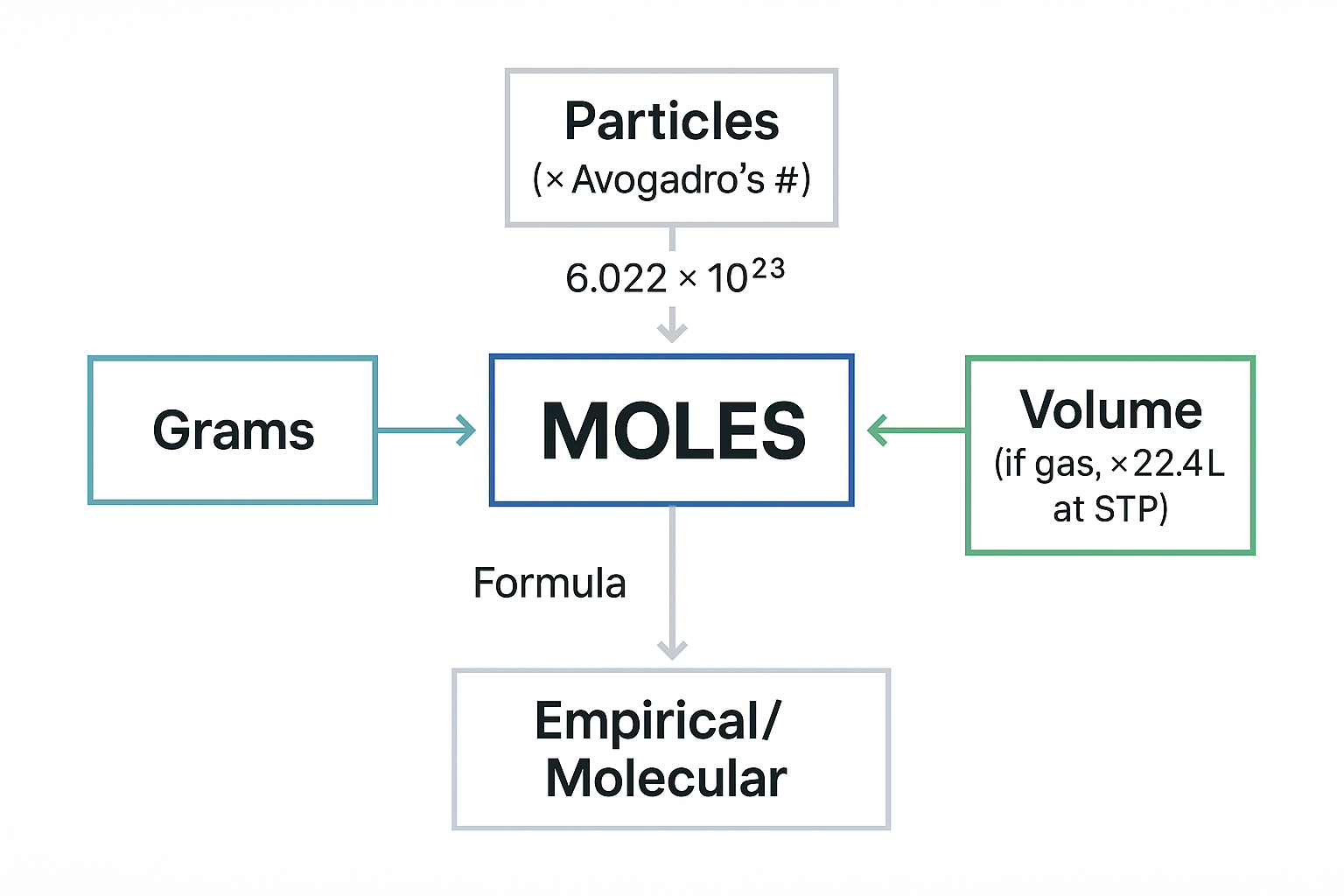
┌─→ Particles (× Avogadro's #) ←┐
     │        6.022 × 10²³            │
     │                                │
Grams ←→ MOLES ←→ Volume (if gas, × 22.4L at STP)
     │     ↕                          │
     │  Formula                       │
     └─→ Empirical/Molecular ←────────┘
🧠 Mnemonic for Mole Conversions: "Mary Goes Picking Violets" = Moles, Grams, Particles, Volume
Balancing Equations Strategy:
- Balance metals first
- Balance non-metals second
- Balance hydrogen third
- Balance oxygen last
- Check your work!
Acids, Bases & pH
pH Scale Essentials:
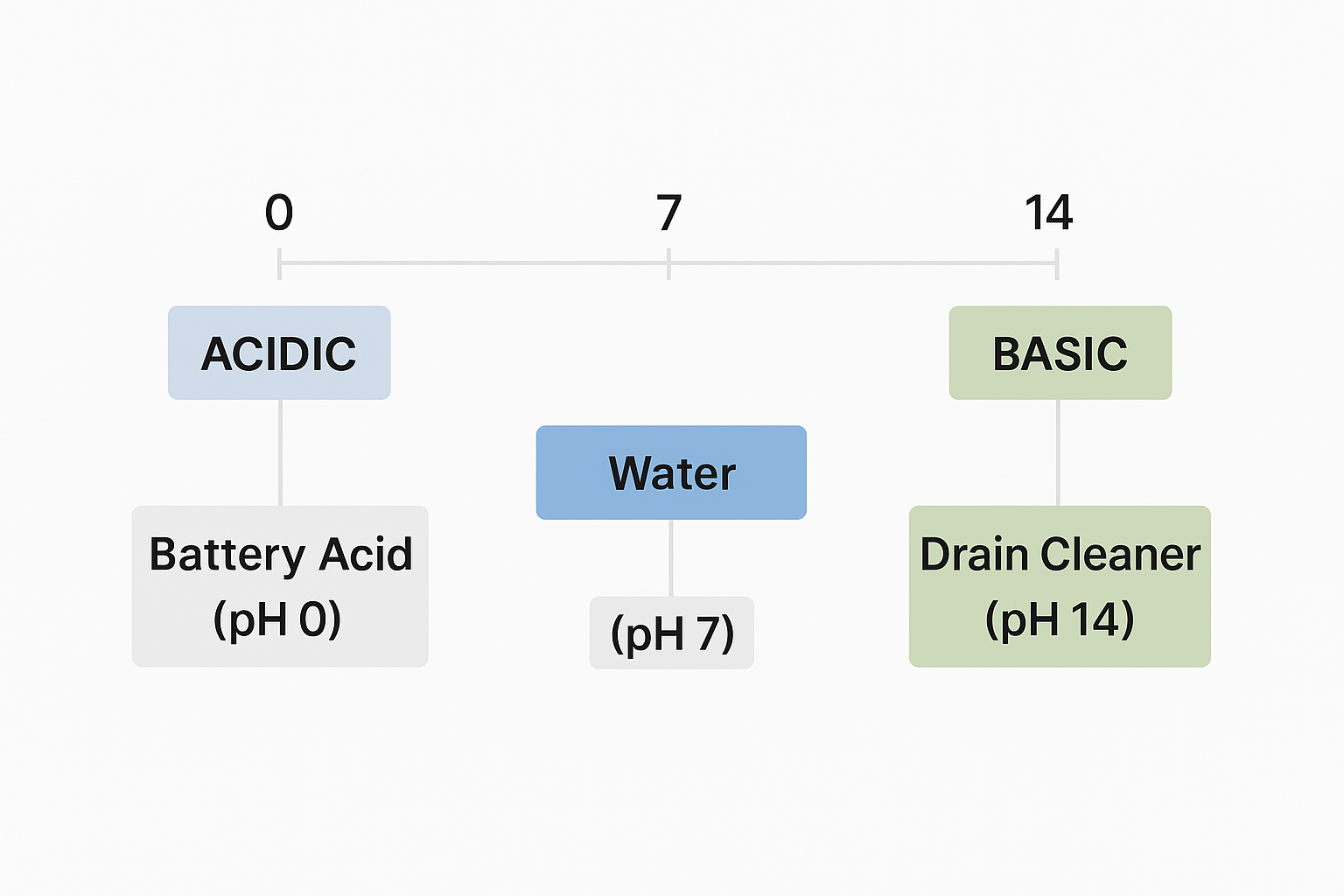
0 ─────────── 7 ─────────── 14
  │   ACIDIC    │   BASIC     │
  │             │             │
  Battery Acid  Water    Drain Cleaner
  (pH 0)        (pH 7)  (pH 14)
Key Formulas:
- pH = -log[H⁺]
- pOH = -log[OH⁻]
- pH + pOH = 14
- [H⁺][OH⁻] = 1.0 × 10⁻¹⁴ (at 25°C)
Strong Acids (memorize these - they dissociate 100%):
- HCl (hydrochloric), HBr (hydrobromic), HI (hydroiodic)
- HNO₃ (nitric), H₂SO₄ (sulfuric), HClO₄ (perchloric)
🧠 Mnemonic: "High Clerk Brought In No Stupid Papers" (HCl, HBr, HI, HNO₃, H₂SO₄, HClO₄)
Core Concepts: Organic Chemistry 🧪
Functional Groups (Must Memorize!)
| Functional Group | Structure | Suffix/Prefix | Example |
|---|---|---|---|
| Alkane | C-C single bonds | -ane | Methane (CH₄) |
| Alkene | C=C double bond | -ene | Ethene (C₂H₄) |
| Alkyne | C≡C triple bond | -yne | Ethyne (C₂H₂) |
| Alcohol | -OH | -ol | Ethanol (C₂H₅OH) |
| Aldehyde | -CHO | -al | Methanal (HCHO) |
| Ketone | C=O (middle) | -one | Propanone (acetone) |
| Carboxylic Acid | -COOH | -oic acid | Ethanoic acid (acetic) |
| Ester | -COO- | -oate | Methyl ethanoate |
| Amine | -NH₂ | -amine | Methylamine |
🧠 Priority Order for Naming (highest to lowest): Carboxylic Acid > Ester > Aldehyde > Ketone > Alcohol > Amine > Alkene > Alkyne > Alkane
Stereochemistry Basics
Chirality - A molecule is chiral if it has a carbon with 4 different groups (asymmetric carbon):
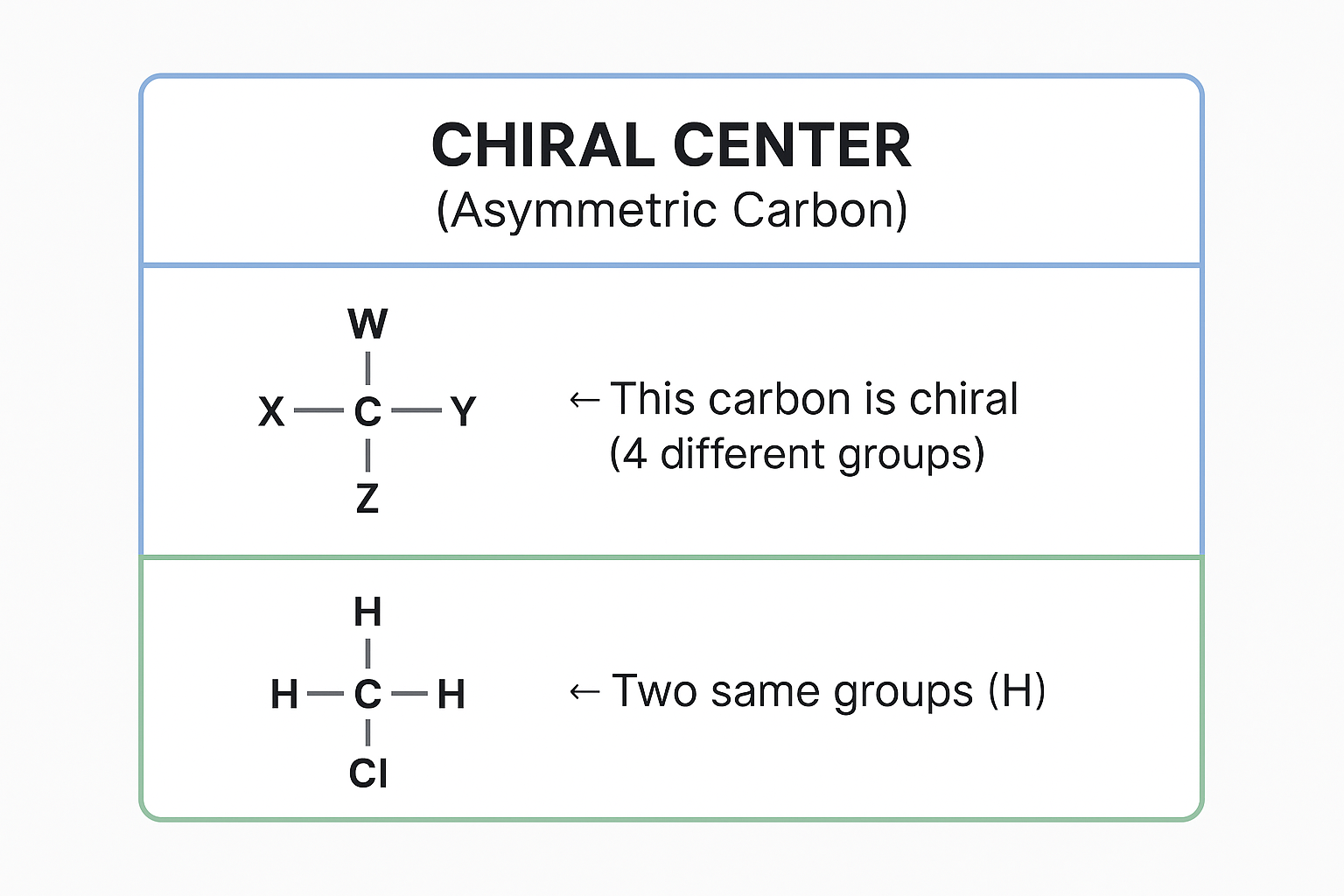
CHIRAL CENTER (Asymmetric Carbon)

        W
        │
    X───C───Y    ← This carbon is chiral
        │         (4 different groups)
        Z

NON-CHIRAL EXAMPLES:
        H
        │
    H───C───H    ← Two same groups (H)
        │
        Cl
R/S Configuration - Use Cahn-Ingold-Prelog priority rules:
- Rank substituents by atomic number (higher = higher priority)
- Orient molecule so lowest priority points away
- Draw arrow from 1→2→3
- Clockwise = R ("rectus"), Counterclockwise = S ("sinister")
💡 DAT Tip: R/S assignment is tested — expect to assign configuration to a straightforward centre. What you will not meet is a molecule with four gnarly substituents needing deep tie-breaking. Practise until CIP ranking on a simple centre is automatic, and make sure you can also recognise chiral centres on sight and tell enantiomers from diastereomers.
Key Reaction Mechanisms
Nucleophile vs. Electrophile:
- Nucleophile ("nucleus-loving"): Electron-rich, negative or neutral, attacks positive sites
- Examples: OH⁻, NH₃, H₂O, RO⁻
- Electrophile ("electron-loving"): Electron-deficient, positive or neutral, accepts electrons
- Examples: H⁺, carbocations (R⁺), carbonyl carbon (C=O)
🧠 Memory Aid: "Nucleophile has numerous electrons" vs. "Electrophile is empty of electrons"
Core Concepts: Perceptual Ability Test (PAT) 🔺
The PAT section is unique to the DAT and tests your spatial reasoning—critical for dental procedures. Practice is essential!
Angle Ranking 📐
Strategy: Estimate angles by comparing to reference angles:
- 90° = Right angle (square corner)
- 45° = Half of 90° (diagonal of square)
- 180° = Straight line
- 60° = Angle in equilateral triangle
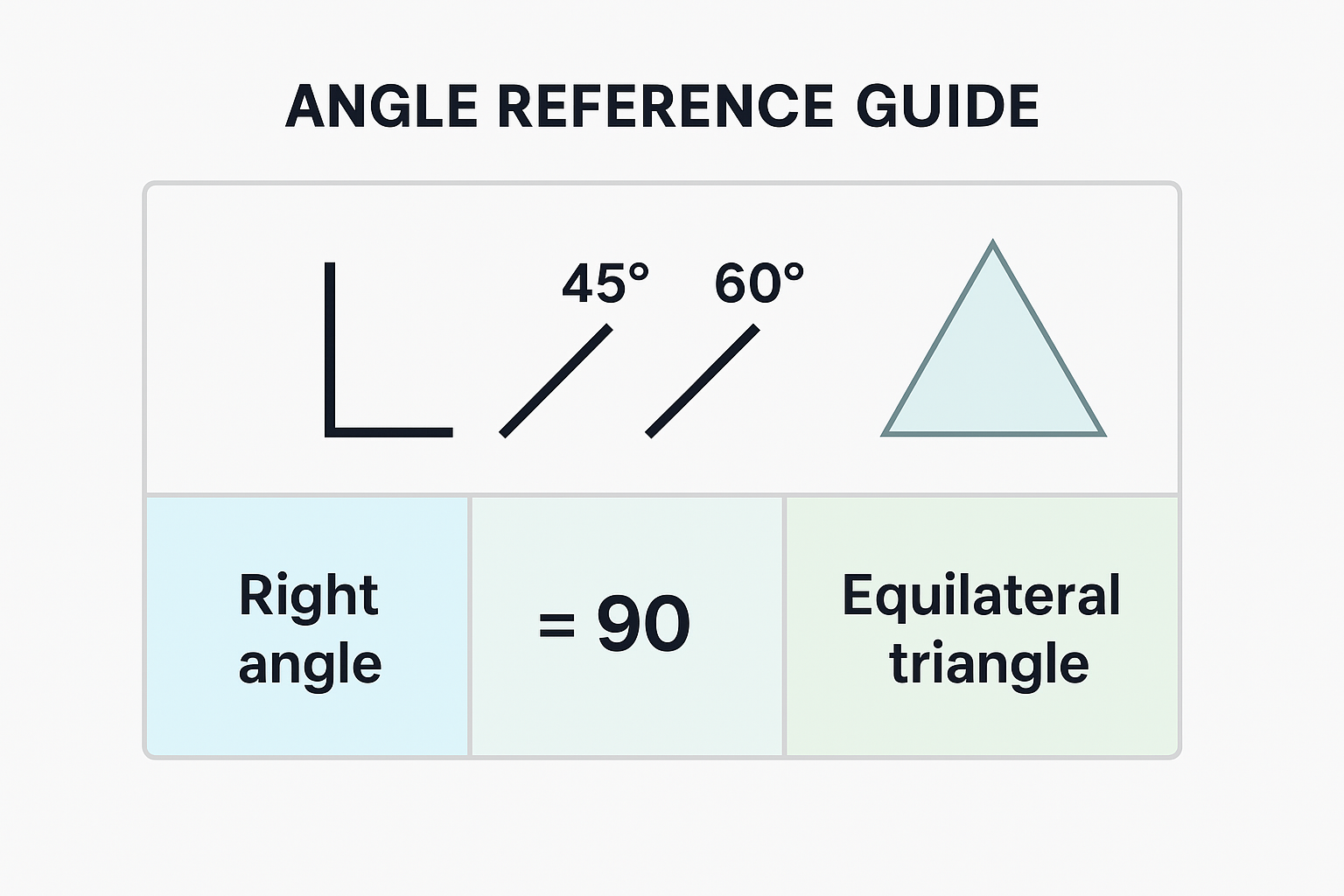
ANGLE REFERENCE GUIDE

    │          ╱           ╱╲
    │         ╱45°        ╱60°╲
────┼──── = 90°     Equilateral triangle
    │
Right angle
💡 Quick Tip: Angles less than 45° are "acute and cute" (small). Angles between 45-90° are still acute. 90-180° are obtuse ("obtuse = obese = big").
Hole Punching 🕳️
Strategy: Visualize the fold sequence carefully:
- Track each fold direction (horizontal, vertical, diagonal)
- When hole is punched, it goes through ALL layers
- Unfold in REVERSE order
- Each layer adds symmetrical holes
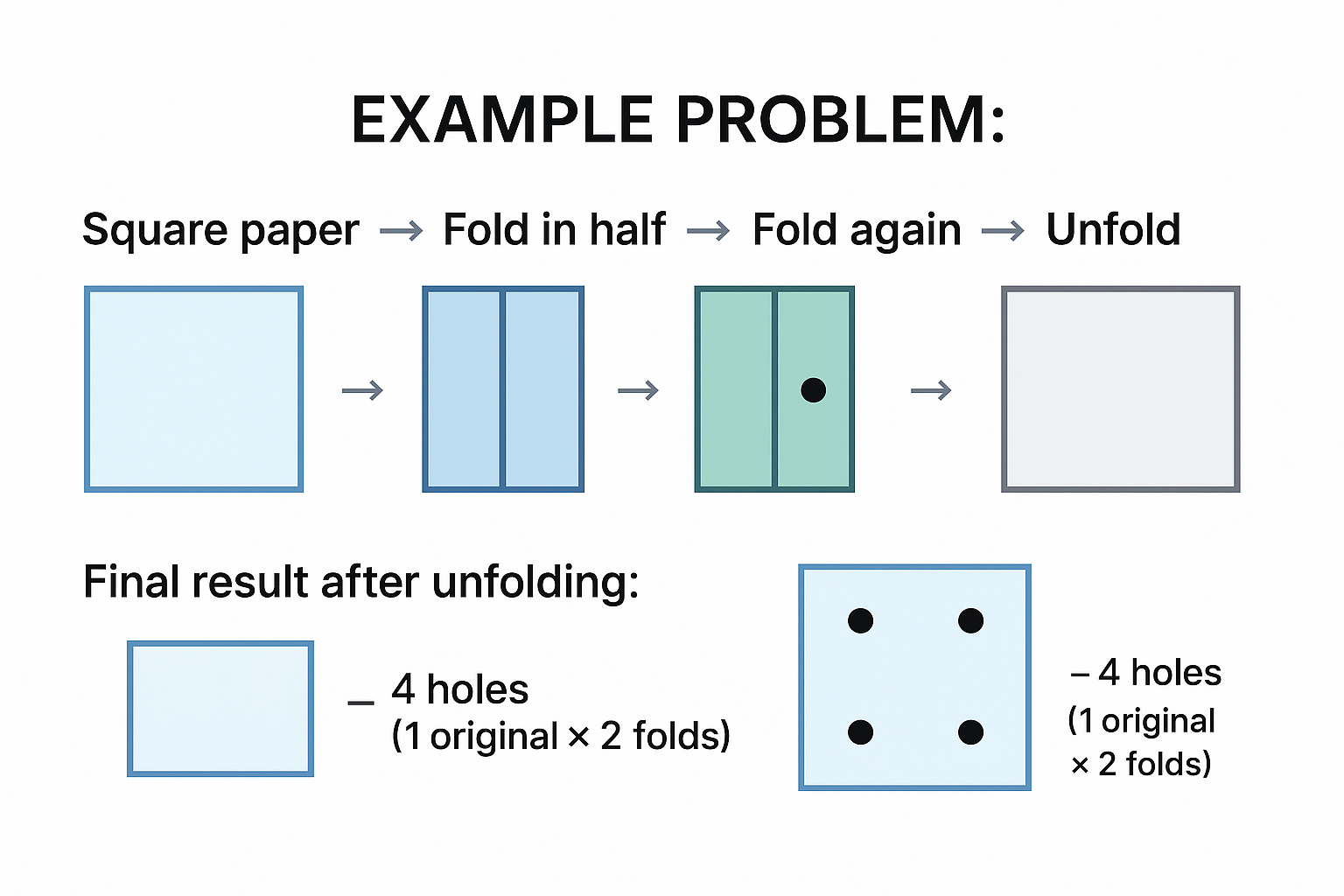
EXAMPLE PROBLEM:

Fold 1 is VERTICAL (width halves).
Fold 2 is HORIZONTAL (height halves).
Two folds in DIFFERENT directions is what gives a
2x2 grid of holes; two folds in the SAME direction
would give four holes in a single row instead.

  start          fold 1 (vert)    fold 2 (horiz)   punch
  ┌───────┐        ┌───┐            ┌───┐          ┌───┐
  │       │        │   │            │   │          │ ● │
  │       │   ->   │   │      ->    └───┘    ->    └───┘
  │       │        │   │           (4 layers)
  └───────┘        └───┘

Unfold in reverse order:

  undo fold 2       undo fold 1
  ┌───┐             ┌───────┐
  │ ● │             │ ●   ● │
  │ ● │      ->     │ ●   ● │   <- 4 holes, 2x2
  └───┘             └───────┘
                     2 folds = 2² = 4 layers = 4 holes
Cube Counting 📦
⚠️ Read the DAT's actual instruction before you use any formula. On the real Perceptual Ability Test, cube counting shows an irregular stack, and the instruction is that the figure is painted on all exposed sides except the bottom, which rests on the table. Two consequences: a cube sitting on the table has its underside unpainted, so it can show fewer painted faces than its position suggests; and a cube in the stack can have 4 or even 5 painted faces, which never happens in a solid cube. The neat n×n×n formulas below describe the idealised "painted on all six sides" puzzle — learn them for the arithmetic, but count the real figure cube by cube.
Strategy: Systematically count cubes by category:
- Fully hidden cubes (no faces visible)
- One face showing
- Two faces showing (edge cubes)
- Three faces showing (corner cubes)
💡 Hidden Cube Formula: For a rectangular stack, count internal cubes = (length-2) × (width-2) × (height-2)
Pattern Folding 📋
Strategy: Look for "impossible" configurations:
- ❌ Adjacent sides in the flat pattern can't be opposite in 3D
- ❌ Check shading/patterns align correctly at edges
- ✅ Identify the base first, then build up mentally
Apertures / Keyhole 🔑
The subtest most people forget exists. You are shown a solid object and five openings, and must pick the opening the object will pass through — it may be rotated first, but not turned once it starts through, and it must pass completely through.
Strategy:
- Find the object's widest silhouette along each of the three axes
- The correct aperture matches one of those silhouettes exactly — no slack, no gaps
- Eliminate any opening that is too small in any dimension, or that has an extra notch the object cannot fill
💡 An opening that is slightly too large is still wrong. The DAT draws these to scale.
View Recognition 👁️
Top-Front-End Views: Practice visualizing objects from different angles:

3D OBJECT VIEWS

     TOP VIEW        FRONT VIEW      END VIEW
   (looking down)   (from front)    (from side)

    ┌─────┐          ┌──┐           ┌───┐
    │     │          │  │           │   │
    │  ■  │          └──┘           │   │
    └─────┘                         └───┘
💡 Strategy: Eliminate wrong answers by finding ONE feature that doesn't match.
Test-Taking Strategies for the 90-Minute Science Section ⏱️
Time Management Blueprint:
| Section | Questions | Recommended Time | Per Question |
|---|---|---|---|
| Biology | 40 | 35 minutes | ~52 seconds |
| General Chemistry | 30 | 26 minutes | ~52 seconds |
| Organic Chemistry | 30 | 26 minutes | ~52 seconds |
| Review/Check | — | 3 minutes | — |
| Total | 100 | 90 minutes | — |
The "Flag and Move" System 🚩
Three-Pass Strategy:
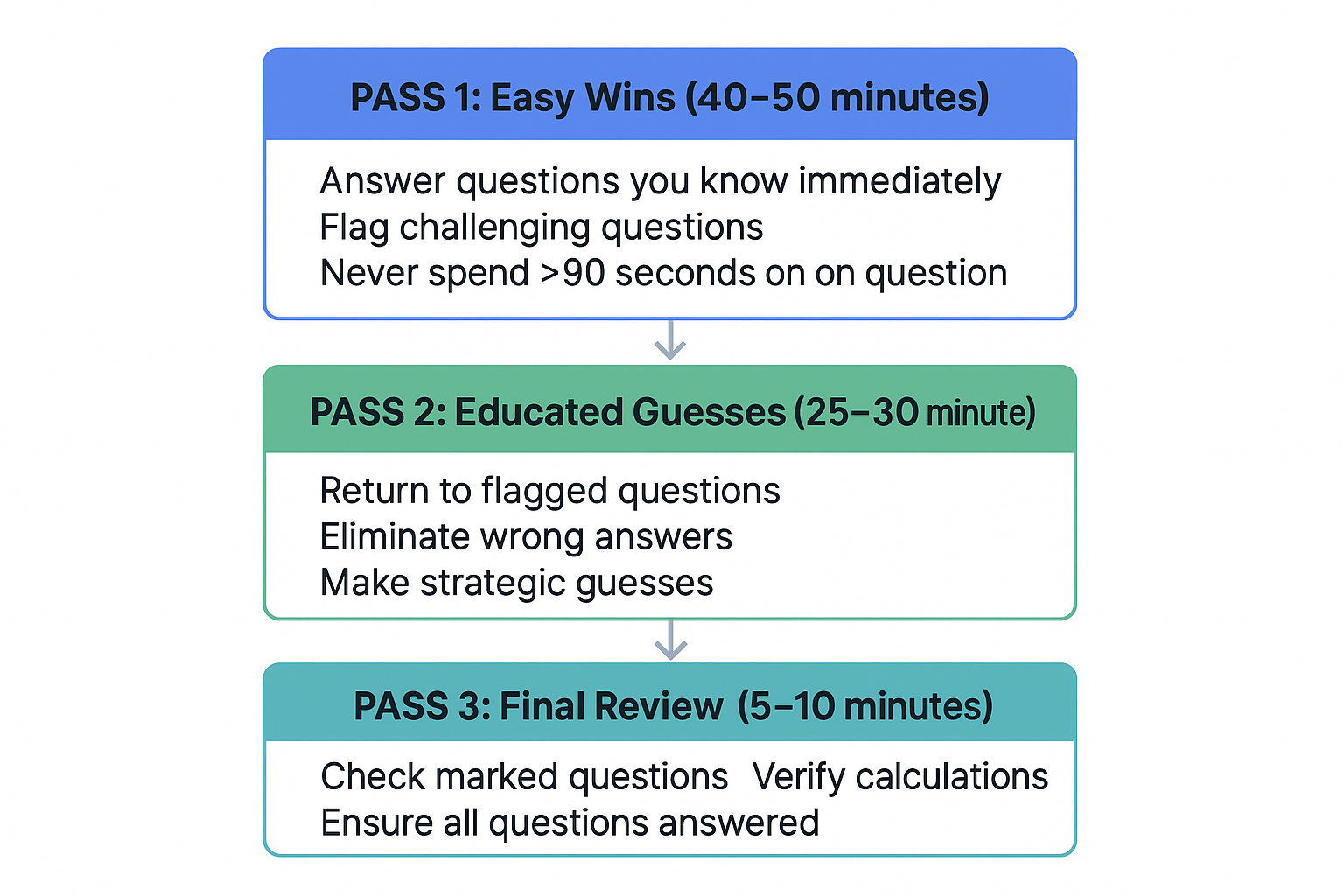
PASS 1: Easy Wins (40-50 minutes)
  ↓
  Answer questions you know immediately
  Flag challenging questions
  Never spend >90 seconds on one question

PASS 2: Educated Guesses (25-30 minutes)
  ↓
  Return to flagged questions
  Eliminate wrong answers
  Make strategic guesses

PASS 3: Final Review (5-10 minutes)
  ↓
  Check marked questions
  Verify calculations
  Ensure all questions answered
Process of Elimination (POE) Techniques ✂️
For Biology Questions:
- ❌ Eliminate extreme answers ("always," "never," "only")
- ❌ Remove options with unfamiliar terminology (often distractors)
- ✅ Choose answers that reflect mainstream biology concepts
For Chemistry Calculations:
- ❌ Eliminate answers with wrong units
- ❌ Remove values that are orders of magnitude off
- ✅ Estimate before calculating (prevents calculation errors)
For Organic Chemistry:
- ❌ Eliminate reactions that violate basic principles (charge balance, octet rule)
- ❌ Remove products with wrong functional groups
- ✅ Focus on electron flow (nucleophile attacks electrophile)
🧠 Golden Rule: When stuck between two answers, choose the one that represents a MORE FUNDAMENTAL concept. The DAT tests core principles, not obscure exceptions.
Examples with Detailed Explanations
Example 1: Biology - Cell Transport 🧬
Question Type: A patient receives an IV solution that is hypotonic relative to their blood cells. What will happen to the red blood cells?
Solution Process:
| Step | Analysis | Reasoning |
|---|---|---|
| 1 | Define "hypotonic" | Lower solute concentration outside cell than inside |
| 2 | Determine water movement | Water moves FROM hypotonic solution INTO cell (osmosis) |
| 3 | Predict outcome | Cell swells as water enters, may burst (lyse) |
Answer: The red blood cells will swell and potentially undergo lysis (burst).
💡 DAT Application: This concept appears in questions about IV solutions, kidney function, and plant cell turgor pressure. Remember: water follows solute ("water goes where the salt is").
Example 2: General Chemistry - pH Calculation 🧪
Question Type: What is the pH of a 0.01 M HCl solution?
Solution Process:
| Step | Work | Result |
|---|---|---|
| 1 | Recognize HCl is a strong acid | 100% dissociation |
| 2 | [H⁺] = 0.01 M = 1 × 10⁻² | Molarity of H⁺ |
| 3 | pH = -log[H⁺] = -log(10⁻²) | Apply pH formula |
| 4 | pH = 2 | Final answer |
Answer: pH = 2
💡 Mental Math Shortcut: For strong acids/bases in "1 × 10⁻ⁿ" format, pH = n (for acids) or pOH = n (for bases). Example: 10⁻³ M HCl → pH = 3 immediately!
Example 3: Organic Chemistry - Functional Group Priority 🧪
Question Type: Name this compound: CH₃-CH₂-CH(OH)-CHO
Solution Process:
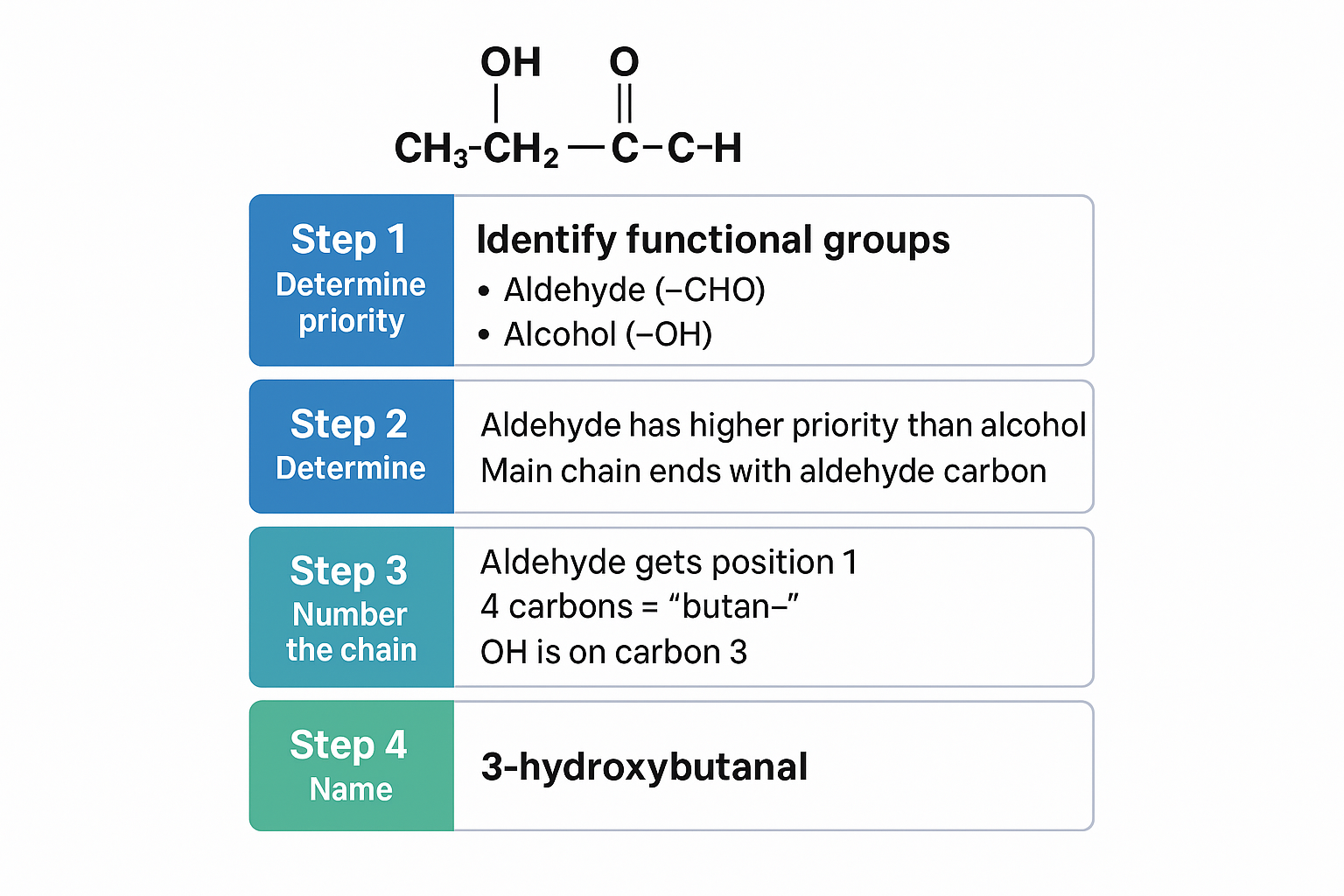
OH  O
       │   ║
CH₃-CH₂-CH-C-H

Step 1: Identify functional groups
  • Aldehyde (-CHO)
  • Alcohol (-OH)

Step 2: Determine priority
  • Aldehyde has higher priority than alcohol
  • Main chain ends with aldehyde carbon

Step 3: Number the chain
  • Aldehyde carbon is C1
  • 4 carbons = "butan-"
  • The OH sits on the carbon next to the
    aldehyde, so it is C2 (not C3 — number
    from the aldehyde end, always)

Step 4: Name
  • 2-hydroxybutanal
Answer: 2-hydroxybutanal
💡 Naming Strategy: Always identify the highest-priority functional group first—this determines the suffix and chain numbering direction.
Example 4: Perceptual Ability - Cube Counting 📦
Question Type: How many cubes have exactly 2 faces painted in this 3×3×3 stack where only the outer surface is painted?
Solution Process:
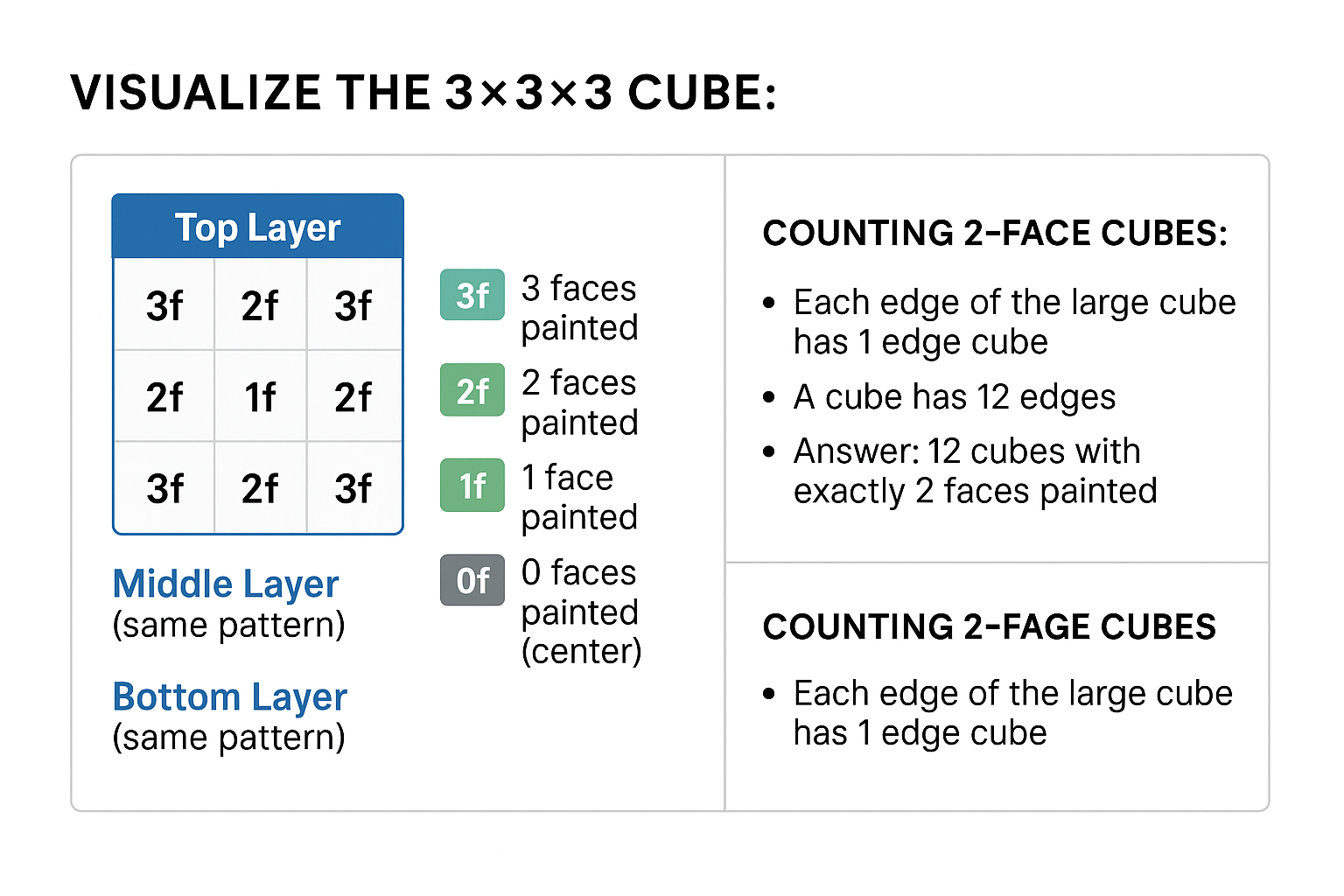
VISUALIZE THE 3×3×3 CUBE:

        Top Layer
     ┌─────┬─────┬─────┐
     │ 3f  │ 2f  │ 3f  │  3f = 3 faces painted (corners)
     ├─────┼─────┼─────┤  2f = 2 faces painted (edges)
     │ 2f  │ 1f  │ 2f  │  1f = 1 face painted (faces)
     ├─────┼─────┼─────┤  0f = 0 faces painted (center)
     │ 3f  │ 2f  │ 3f  │
     └─────┴─────┴─────┘

Bottom Layer: identical to the top layer.
Middle Layer: NOT the same — it has no top or
bottom paint, so every cube loses one face:
     ┌─────┬─────┬─────┐
     │ 2f  │ 1f  │ 2f  │
     ├─────┼─────┼─────┤
     │ 1f  │ 0f  │ 1f  │  ← the only 0-face cube
     ├─────┼─────┼─────┤
     │ 2f  │ 1f  │ 2f  │
     └─────┴─────┴─────┘

COUNTING 2-FACE CUBES:
• Top layer: 4 (the edge-midpoints)
• Bottom layer: 4
• Middle layer: 4 (its vertical edges)
• Answer: 12 cubes with exactly 2 faces painted
  (= 12 edges of the big cube × 1 cube per edge)
Answer: 12 cubes
💡 Universal Formula for n×n×n cube:
- Corner cubes (3 faces): Always 8
- Edge cubes (2 faces): 12(n-2)
- Face cubes (1 face): 6(n-2)²
- Internal cubes (0 faces): (n-2)³
Common Mistakes to Avoid ⚠️
Biology Mistakes
❌ Confusing mitosis and meiosis
- Mitosis = 2 daughter cells, diploid (2n), identical to parent
- Meiosis = 4 daughter cells, haploid (n), genetic variation
- 🧠 Mnemonic: "Meiosis makes megametes" (sex cells)
❌ Mixing up DNA vs RNA
- DNA: Deoxyribose sugar, thymine (T), double-stranded
- RNA: Ribose sugar, uracil (U), single-stranded
- Remember: RNA is "U"nique (has Uracil)
❌ Forgetting about negative feedback loops
- Most homeostatic mechanisms use negative feedback (not positive)
- Example: High blood glucose → insulin release → glucose drops → insulin stops
General Chemistry Mistakes
❌ pH calculation errors
- pH scale is logarithmic: pH 5 is 10× more acidic than pH 6
- Don't forget: pH + pOH = 14 (not pH + pOH = 7)
❌ Periodic trend confusion
- Atomic radius increases going DOWN and LEFT
- Electronegativity increases going UP and RIGHT
- They're opposite trends!
❌ Balancing equations prematurely
- Identify reaction type first (synthesis, decomposition, combustion, etc.)
- This helps predict products before balancing
Organic Chemistry Mistakes
❌ Ignoring stereochemistry
- Enantiomers have opposite biological activity
- DAT often asks about chiral centers in drug molecules
❌ Forgetting electron pushing
- Nucleophiles have electrons to donate (think: negative charges, lone pairs)
- Electrophiles accept electrons (think: positive charges, partial positive)
- Arrows go FROM nucleophile TO electrophile
❌ Misidentifying functional groups
- Aldehyde: -CHO (at the END of chain)
- Ketone: C=O (in the MIDDLE of chain)
- Don't confuse them!
Perceptual Ability Mistakes
❌ Not practicing enough
- PAT requires MUSCLE MEMORY, not just understanding
- Practice 30+ minutes daily for 2-3 weeks before test
❌ Second-guessing yourself
- Your first instinct on spatial problems is usually correct
- Only change answers if you find a clear error
❌ Spending too long on one problem
- The PAT gives you 60 minutes for 90 questions — 40 seconds each, not a minute
- Flag and move on if stuck
Key Takeaways 📚
🎯 Quick Reference Card: DAT Science Section
Time Management:
- Biology: 40 questions in 35 min (~52 s each)
- Gen Chem: 30 questions in 26 min (~52 s each)
- Org Chem: 30 questions in 26 min (~52 s each)
- Review: 3 min
- Total 90 min — matches the blueprint table above; any plan summing past 90 cannot be executed
High-Yield Biology Topics:
- Cell transport (active/passive)
- DNA replication & protein synthesis
- Mendelian genetics & inheritance
- Natural selection & evolution
- Anatomy (especially dental-relevant: muscles, nerves, blood vessels)
High-Yield General Chemistry:
- Stoichiometry & mole conversions
- pH/pOH calculations
- Periodic trends
- Thermodynamics (ΔH, ΔS, ΔG)
- Gas laws (PV=nRT)
High-Yield Organic Chemistry:
- Functional group identification
- IUPAC nomenclature
- Nucleophile vs electrophile
- Stereochemistry basics (R/S, E/Z)
- Common reactions (substitution, elimination, addition)
PAT Strategies: (six subtests, 15 questions each)
- Apertures: match the object's widest silhouette to the opening, exactly
- Angle ranking: Use 45° and 90° references
- Hole punching: Unfold in reverse order
- Cube counting: count the actual figure cube by cube (bottom face unpainted); the n×n×n formulas are drill practice, not the test rule
- Pattern folding: Look for impossible configurations
- View recognition: Eliminate one wrong feature at a time
Test Day Tips:
- Use three-pass system (easy → medium → hard)
- Never leave questions blank (no penalty for guessing)
- Trust first instincts on spatial problems
- Check units on all calculations
- Remember: Breadth over depth—know fundamentals cold!
Further Study 📖
American Dental Association DAT Resources: https://www.ada.org/education-careers/dental-admission-test - Official test structure, practice materials, and registration
Khan Academy MCAT Prep (applicable to DAT): https://www.khanacademy.org/test-prep/mcat - Free comprehensive biology and chemistry review with practice questions
DAT Bootcamp: https://www.datbootcamp.com/ - Specialized DAT preparation with perceptual ability practice software and full-length practice tests
Ready to test your knowledge? The practice questions below will help reinforce these concepts and prepare you for DAT-style questions. Remember: focus on understanding principles, not memorizing facts. Good luck! 🦷✨