Constitutional Law and Criminal Law & Procedure
Master foundational concepts in Constitutional Law and Criminal Law & Procedure for the MBE, covering judicial review, federal powers, individual rights, elements of crimes, constitutional criminal procedure, and common defenses.
SPACED REPETITION · 25 practice questions
Make this lesson stick.
Answer questions, get feedback, and build your review pool. Correct answers move toward longer review intervals; missed answers return sooner.
Sign in to practice →Master Constitutional Law and Criminal Law & Procedure with free flashcards and spaced repetition practice. This lesson covers judicial review, federal powers (commerce clause, taxing/spending), individual rights (due process, equal protection, First Amendment), elements of crimes (actus reus, mens rea), homicide classifications, inchoate offenses, and Fourth, Fifth, and Sixth Amendment protections—essential concepts for passing the MBE (Multistate Bar Examination).
Welcome to MBE Fundamentals! 🏛️⚖️
The Multistate Bar Examination tests your knowledge of black-letter law across seven subjects. This lesson focuses on two of the most heavily tested areas: Constitutional Law and Criminal Law & Procedure. These subjects appear in approximately 50 of the 200 MBE questions, making them critical to your success.
Understanding these foundational principles will help you spot common fact patterns, avoid trap answers, and apply the law correctly under pressure. Let's build your constitutional and criminal law framework from the ground up!
📜 PART 1: CONSTITUTIONAL LAW
Judicial Review and Federal Powers
Judicial review is the power of federal courts to review the constitutionality of legislative and executive actions. Established in Marbury v. Madison (1803), this doctrine allows courts to strike down laws that violate the Constitution.
🔑 Key Federal Powers Framework
| Power Source | Scope | Limitations |
|---|---|---|
| Commerce Clause | Congress may regulate (1) channels of interstate commerce, (2) instrumentalities of interstate commerce, (3) activities substantially affecting interstate commerce | Cannot regulate non-economic intrastate activity that doesn't substantially affect interstate commerce |
| Taxing Power | Congress may tax for general welfare; no need to prove regulatory purpose | Cannot be a direct unapportioned tax on property (except income tax per 16th Amendment) |
| Spending Power | Congress may spend for general welfare and attach conditions to federal funds | Conditions must be (1) clearly stated, (2) related to federal interest, (3) not unduly coercive |
| Executive Power | President enforces laws, conducts foreign affairs, commander-in-chief of military | Cannot make domestic law without congressional authorization; subject to checks and balances |
💡 MBE Tip: When analyzing Commerce Clause questions, look for whether the activity is commercial/economic. Non-economic intrastate activity (like gun possession near schools or gender-motivated violence) typically falls outside Congress's commerce power.
The State Action Doctrine: Constitutional rights generally protect against government action, not private conduct. Private actors can violate constitutional rights only when they perform traditional government functions (e.g., running a company town) or have significant government involvement (e.g., government enforcement of discriminatory private agreements).
STATE ACTION ANALYSIS FLOWCHART

    ❓ Constitutional violation alleged
           |
           ↓
    Is defendant a government actor?
      /                    \
    YES                     NO
     |                       |
     ↓                       ↓
  Proceed with         Is there state action?
  constitutional         /              \
  analysis             YES               NO
                        |                 |
                        ↓                 ↓
                   Traditional        ❌ No constitutional
                   government            violation
                   function OR           (private action)
                   significant
                   government
                   entanglement
                        |
                        ↓
                   ✅ Proceed with
                   constitutional
                   analysis
Individual Rights: Due Process and Equal Protection
The Due Process Clauses (5th Amendment for federal government, 14th Amendment for states) protect against deprivation of "life, liberty, or property" without due process of law.
Procedural Due Process requires notice and a hearing before the government deprives someone of a protected interest. The amount of process due depends on:
- The private interest affected
- The risk of erroneous deprivation
- The government's interest
Substantive Due Process protects fundamental rights from government interference. Fundamental rights include:
- Right to marry
- Right to have children
- Right to control upbringing of children
- Right to bodily integrity
- Right to use contraception
- Right to interstate travel
- Right to vote
⚠️ Common Mistake: Economic regulations (like licensing requirements or price controls) are NOT subject to strict scrutiny. They need only a rational basis.
Equal Protection (14th Amendment) requires that similarly situated people be treated alike. The level of scrutiny depends on the classification:
| Scrutiny Level | When Applied | Test | Burden |
|---|---|---|---|
| Strict Scrutiny | Suspect classifications (race, national origin, alienage*) OR fundamental rights burdened | Necessary to achieve compelling government interest | Government must prove |
| Intermediate Scrutiny | Quasi-suspect classifications (gender, illegitimacy) | Substantially related to important government interest | Government must prove |
| Rational Basis | All other classifications (age, disability, wealth, etc.) | Rationally related to legitimate government interest | Challenger must prove no rational basis |
*Alienage receives strict scrutiny for state laws but only rational basis for federal immigration laws.
💡 Memory Device: "CARIN" for strict scrutiny classifications:
- Citizenship (alienage, state laws only)
- Ancestry (national origin)
- Race
- Interstate travel (fundamental right)
- Nuptial rights (marriage, fundamental right)
First Amendment Freedoms 🗣️📰⛪
Freedom of Speech protects against content-based restrictions unless the government can satisfy strict scrutiny. Content-neutral time, place, and manner restrictions need only be narrowly tailored to a significant government interest and leave open alternative channels of communication.
🗣️ Unprotected Speech Categories
These categories receive NO First Amendment protection:
| Category | Definition | Example |
|---|---|---|
| Incitement | Speech directed to inciting imminent lawless action and likely to produce such action | "Let's burn down this building right now!" (said to angry mob) |
| Fighting Words | Words that by their very utterance inflict injury or tend to incite immediate breach of peace | Face-to-face insults likely to provoke violent response |
| True Threats | Statements expressing serious intent to commit unlawful violence against person or group | "I'm going to kill you tomorrow" (said seriously) |
| Obscenity | Material that (1) appeals to prurient interest, (2) depicts sexual conduct in patently offensive way, (3) lacks serious literary/artistic/political/scientific value (Miller test) | Hardcore pornography with no redeeming value |
| Defamation | False statement of fact harming reputation (public figures must prove actual malice) | Newspaper falsely reports mayor embezzled funds |
Freedom of Religion has two components:
Establishment Clause ("Congress shall make no law respecting an establishment of religion"): Government cannot endorse, favor, or prefer one religion over another or religion over non-religion. Under current doctrine, government action regarding religion must have a secular purpose and primary effect that neither advances nor inhibits religion.
Free Exercise Clause: Government cannot punish religious beliefs. Neutral laws of general applicability that burden religious practice need only satisfy rational basis review. Laws specifically targeting religious practice must satisfy strict scrutiny.
💡 MBE Tip: When both religion clauses are implicated, the Free Exercise Clause generally takes priority. The government has more leeway to accommodate religion than to restrict it.
⚖️ PART 2: CRIMINAL LAW & PROCEDURE
Elements of Crimes: Actus Reus and Mens Rea
Every crime (except strict liability offenses) requires both a physical act (actus reus) and a mental state (mens rea) occurring simultaneously.
Actus Reus: A voluntary physical act. Mere thoughts, status, or involuntary acts (reflexes, sleepwalking, acts under duress) are insufficient. Omissions can satisfy actus reus only when there's a legal duty to act (statutory duty, contract, special relationship, voluntary assumption of care, or defendant created the peril).
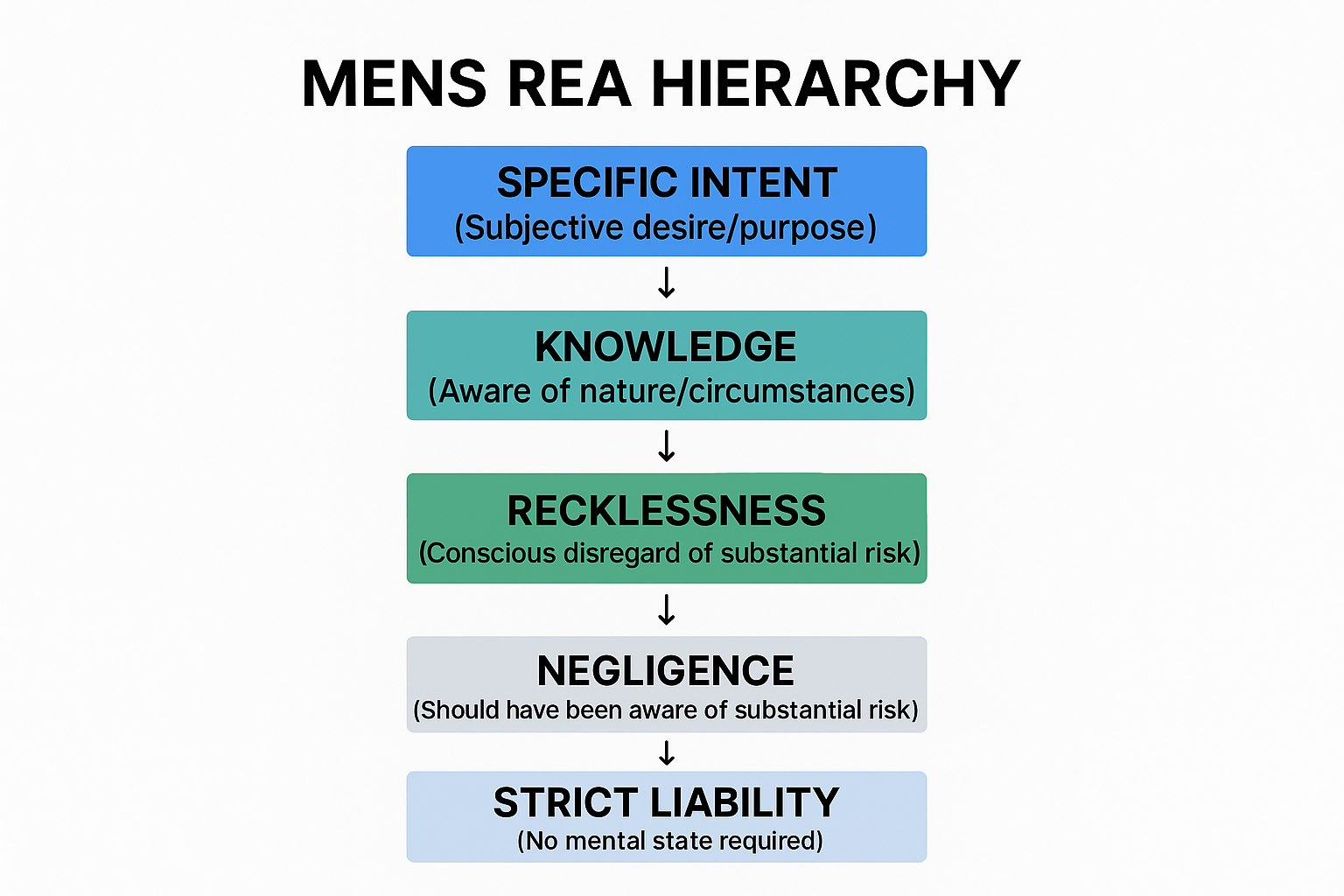
Mens Rea - Four common law mental states (from most to least culpable):
View original ASCII
MENS REA HIERARCHY🎯 SPECIFIC INTENT (Subjective desire/purpose) | ↓ 🔍 KNOWLEDGE (Aware of nature/circumstances) | ↓ ⚠️ RECKLESSNESS (Conscious disregard of substantial risk) | ↓ 📋 NEGLIGENCE (Should have been aware of substantial risk) | ↓ ❌ STRICT LIABILITY (No mental state required)</pre>
💡 Memory Device for Specific Intent Crimes: "Students Can Always Fake A Laugh, Even For Ridiculous Bar Examiners"
- Solicitation
- Conspiracy
- Attempt
- First degree murder
- Assault (with intent to commit battery)
- Larceny and Embezzlement
- False pretenses
- Robbery
- Burglary
- Embezzlement (already listed in Larceny)
Alternative: "Some Convicts Attempt First-degree Assaults, Larcenies, Embezzlements, Forgeries, Robberies, and Burglaries"
Inchoate Offenses (Incomplete Crimes) 🔄
Solicitation: Asking, encouraging, or commanding another to commit a crime with intent that the crime be committed. Completed upon the asking—no agreement needed. Not merged with completed crime.
Conspiracy: Agreement between two or more people to commit a crime, plus an overt act in furtherance (in most jurisdictions). Modern trend uses unilateral approach (one guilty mind suffices). Conspiracy does NOT merge with the completed crime—defendant can be convicted of both.
Attempt: (1) Specific intent to commit the crime, PLUS (2) substantial step toward commission that goes beyond mere preparation. Factual impossibility is NO defense; legal impossibility may be. Attempt merges with the completed crime.
| Inchoate Crime | Actus Reus | Mens Rea | Merger? |
|---|---|---|---|
| Solicitation | Asking/commanding another to commit crime | Intent that person commit crime | Yes (merges into conspiracy) |
| Conspiracy | Agreement + overt act | Intent to agree + intent that crime be committed | NO (can be convicted of both conspiracy and substantive crime) |
| Attempt | Substantial step beyond mere preparation | Specific intent to commit target crime | Yes (merges into completed crime) |
⚠️ Common Mistake: Students confuse conspiracy's non-merger rule. You CAN be convicted of both conspiracy to commit murder AND murder itself.
Homicide: Murder and Manslaughter 💀
Common Law Murder: Unlawful killing of another human with malice aforethought. Malice can be shown by:
- Intent to kill
- Intent to inflict serious bodily injury
- Depraved heart (reckless indifference to unjustifiably high risk to human life)
- Felony murder (killing during commission of inherently dangerous felony)
First-Degree Murder (statutory): Premeditated and deliberate killing, OR felony murder during enumerated felonies (typically BARRK: Burglary, Arson, Rape, Robbery, Kidnapping).
Second-Degree Murder: All other murders (malice present but no premeditation or not during enumerated felony).
Voluntary Manslaughter: Intentional killing in "heat of passion" with adequate provocation. Requires:
- Adequate provocation (would cause reasonable person to lose control)
- Defendant actually provoked
- Insufficient time to cool off
- Defendant did not actually cool off
💡 Classic Adequate Provocation: Discovering spouse in adultery, being subjected to serious battery. Mere words alone are usually insufficient.
Involuntary Manslaughter: Unintentional killing resulting from:
- Criminal negligence (gross deviation from reasonable care), OR
- Misdemeanor manslaughter (killing during commission of malum in se misdemeanor or unenumerated felony)
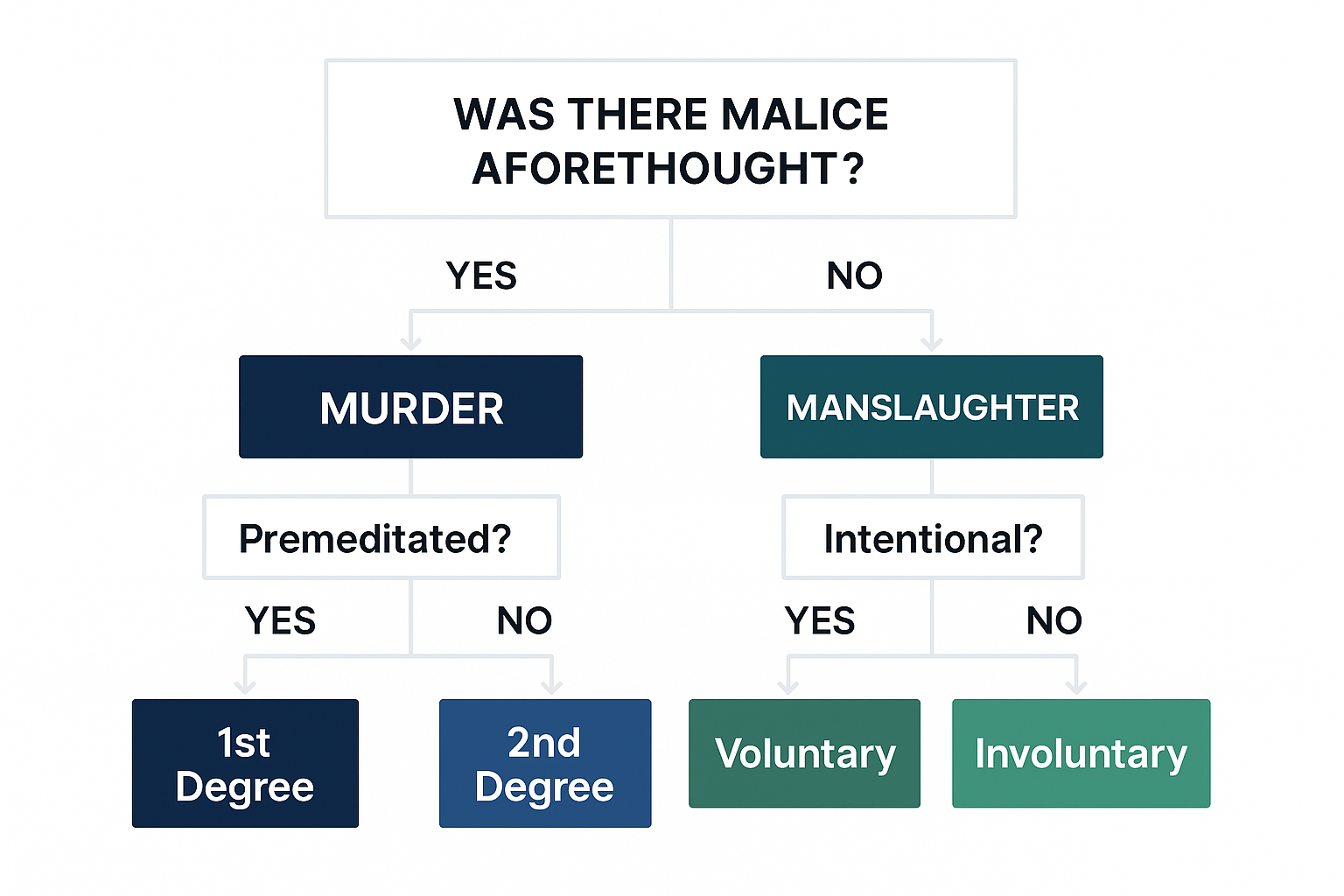
🔪 Homicide Classification Flowchart
View original ASCII
Was there malice aforethought?
      /              \
    YES               NO
     |                 |
     ↓                 ↓
  MURDER          MANSLAUGHTER
     |                 |
Premeditated?      Intentional?
  /      \          /        \
YES      NO       YES         NO
 |        |        |           |
 ↓        ↓        ↓           ↓
1st     2nd    Voluntary  Involuntary
Degree  Degree
Other Common Crimes 🏠💰
Larceny: Trespassory taking and carrying away of personal property of another with intent to permanently deprive.
Embezzlement: Fraudulent conversion of property of another by person in lawful possession.
Robbery: Larceny accomplished by force or intimidation. Robbery is a specific intent crime requiring intent to permanently deprive.
Burglary (common law): Breaking and entering of dwelling of another at nighttime with intent to commit a felony therein. Modern statutes eliminate "breaking," "nighttime," and "dwelling" requirements.
💡 Key Distinction: Larceny requires trespassory taking (without permission). Embezzlement requires lawful possession initially. If defendant had possession lawfully then converted property, it's embezzlement, not larceny.
Arson (common law): Malicious burning of dwelling of another. "Burning" requires damage to structure itself (charring), not just smoke damage.
Criminal Defenses 🛡️
Self-Defense: Non-deadly force may be used when reasonably necessary to prevent imminent unlawful harm. Deadly force may be used to prevent death or serious bodily injury. No duty to retreat before using non-deadly force. Traditional rule: duty to retreat before using deadly force (except in own home). Modern trend: no duty to retreat if lawfully present.
⚠️ Aggressor Rule: Initial aggressor cannot claim self-defense UNLESS they fully withdraw and communicate withdrawal, or victim responds with excessive force.
Insanity: Defendant lacks moral responsibility due to mental disease or defect. Tests vary:
- M'Naghten Test (majority): Defendant didn't know nature/quality of act OR didn't know act was wrong
- Irresistible Impulse: Defendant unable to control conduct
- MPC Test: Defendant lacked substantial capacity to appreciate wrongfulness or conform conduct to law
Intoxication:
- Voluntary intoxication: Defense ONLY to specific intent crimes (can negate specific intent)
- Involuntary intoxication (forced, unknowing, or prescribed medication): Defense to all crimes
🔍 PART 3: CONSTITUTIONAL CRIMINAL PROCEDURE
Fourth Amendment: Search and Seizure 🚔
The Fourth Amendment protects against unreasonable searches and seizures. Government must have probable cause and (generally) a warrant.
Standing: Defendant must have reasonable expectation of privacy in place searched. Property ownership not required; overnight guest has standing in host's home, but casual visitor does not.
Warrant Requirements:
- Probable cause (fair probability that contraband/evidence is in place to be searched)
- Particularity (specifically describe place to be searched and items to be seized)
- Issued by neutral magistrate
- Based on information not stale
Warrant Exceptions ("ESCAPIST"):
- Exigent circumstances
- Search incident to arrest (within arrestee's wingspan)
- Consent (voluntary, from someone with authority)
- Automobile exception (probable cause vehicle contains contraband)
- Plain view (lawful vantage point, immediately apparent as contraband)
- Inventory search (standardized procedure)
- Stop and frisk (Terry stop: reasonable suspicion of criminal activity; frisk: reasonable belief armed/dangerous)
- Transportation checkpoints (systematic, non-discretionary)
💡 Exclusionary Rule: Evidence obtained in violation of Fourth Amendment must be excluded at trial, along with derivative evidence ("fruit of the poisonous tree"). Exceptions: inevitable discovery, independent source, attenuation.
Fifth Amendment: Self-Incrimination and Miranda 🤐
Miranda Rights: Required when there is (1) custodial interrogation (2) by police. "Custody" = reasonable person wouldn't feel free to leave. "Interrogation" = direct questioning or conduct reasonably likely to elicit incriminating response.
📋 Miranda Requirements
Police must inform suspect of:
- Right to remain silent
- Anything said can be used against them in court
- Right to attorney
- Attorney will be appointed if cannot afford one
Waiver must be knowing, intelligent, and voluntary.
Invoking Rights:
- Right to silence: Questioning must cease (but police may re-approach after significant time has passed)
- Right to counsel: All questioning must cease until attorney present
⚠️ Common Mistake: Miranda applies ONLY to custodial interrogation. Volunteered statements, public safety exception, and routine booking questions don't require Miranda.
Double Jeopardy: Fifth Amendment bars being tried twice for same offense. Jeopardy "attaches" when jury is sworn (jury trial) or first witness sworn (bench trial). Exceptions:
- Mistrial for manifest necessity
- Defendant appeals conviction
- Separate sovereigns (state and federal governments are separate)
- Same act violating two different statutes (if each requires proof of element the other doesn't)
Sixth Amendment: Right to Counsel and Confrontation ⚖️👨⚖️
Right to Counsel: Attaches at all critical stages after formal charges filed (arraignment, trial, sentencing, first appeal). Defendant entitled to effective assistance of counsel; ineffective assistance requires showing (1) deficient performance AND (2) but-for prejudice.
Confrontation Clause: Defendant has right to confront witnesses. Testimonial hearsay (statements made for purpose of establishing facts for prosecution) cannot be admitted unless:
- Declarant unavailable, AND
- Defendant had prior opportunity to cross-examine
Non-testimonial hearsay (excited utterances, dying declarations, co-conspirator statements) doesn't implicate Confrontation Clause.
⚠️ Common Mistakes on the MBE
Confusing levels of scrutiny: Race = strict scrutiny, gender = intermediate scrutiny, age = rational basis. Don't mix them up!
Forgetting state action requirement: Private discrimination is generally NOT a constitutional violation unless there's significant government involvement.
Misapplying conspiracy merger: Conspiracy does NOT merge with the completed crime. Defendant can be convicted of both.
Overlooking mens rea requirements: Match the mental state to the crime. Specific intent crimes require proof of specific intent; general malice crimes don't.
Missing warrant exceptions: Know your exceptions cold. Many Fourth Amendment questions test whether police needed a warrant.
Confusing Miranda with Sixth Amendment right to counsel: Miranda (5th Amendment) applies during custodial interrogation pre-charge. Sixth Amendment right to counsel applies post-charge at critical stages.
Forgetting adequate provocation requirements for voluntary manslaughter: ALL four requirements must be met—provocation, actually provoked, no time to cool, didn't cool.
Applying strict scrutiny to economic regulations: Economic regulations get only rational basis review unless a fundamental right is burdened.
🎯 Key Takeaways
✅ Constitutional Law:
- Judicial review allows courts to strike down unconstitutional laws
- Commerce Clause permits regulation of interstate commerce and activities substantially affecting it
- Constitutional rights protect against government action, not private conduct
- Scrutiny levels: strict (race, fundamental rights), intermediate (gender), rational basis (everything else)
- First Amendment protects speech unless it falls into unprotected category (incitement, fighting words, true threats, obscenity)
- Government cannot establish religion or unduly burden free exercise
✅ Criminal Law:
- Every crime requires actus reus (voluntary act) + mens rea (mental state), occurring simultaneously
- Specific intent crimes are more difficult to prove and allow voluntary intoxication defense
- Inchoate offenses: solicitation and attempt merge; conspiracy doesn't merge
- Murder requires malice aforethought; manslaughter is unlawful killing without malice
- Common property crimes: larceny (trespassory taking), embezzlement (lawful possession then conversion), robbery (larceny by force)
✅ Criminal Procedure:
- Fourth Amendment requires probable cause and warrant (subject to exceptions)
- Miranda applies to custodial interrogation by police
- Fifth Amendment protects against self-incrimination and double jeopardy
- Sixth Amendment right to counsel attaches at critical stages after formal charges
- Confrontation Clause bars testimonial hearsay unless declarant unavailable and defendant had prior cross-examination opportunity
📋 Quick Reference Card: MBE Criminal Law & Constitutional Law
| Topic | Key Rule | Common Trap |
|---|---|---|
| Commerce Clause | Can regulate channels, instrumentalities, activities substantially affecting interstate commerce | Non-economic intrastate activity generally outside power |
| Equal Protection | Strict (race), intermediate (gender), rational basis (other) | Economic regulations get rational basis only |
| State Action | Constitutional rights protect against government, not private action | Private discrimination usually not unconstitutional |
| Free Speech | Content-based restrictions get strict scrutiny | Unprotected categories: incitement, fighting words, true threats, obscenity |
| Malice Aforethought | Intent to kill, intent to seriously injure, depraved heart, or felony murder | Intent to seriously injure = murder, not manslaughter |
| Conspiracy | Agreement + overt act; does NOT merge | Can be convicted of both conspiracy and completed crime |
| Felony Murder | Killing during inherently dangerous felony (BARRK) | Applies even if killing unintentional/accidental |
| Voluntary Manslaughter | Heat of passion killing with adequate provocation | Need all four elements (provocation, provoked, no time to cool, didn't cool) |
| Self-Defense | Reasonable force to prevent imminent unlawful harm | Initial aggressor can't claim unless withdraws/communicates withdrawal |
| Fourth Amendment | Probable cause + warrant required (with exceptions) | Know warrant exceptions (ESCAPIST) |
| Miranda | Custodial interrogation by police requires warnings | Doesn't apply to volunteered statements or non-custodial questioning |
| Double Jeopardy | Can't be tried twice for same offense | Separate sovereigns (state/federal) can both prosecute |
| Sixth Amendment Counsel | Attaches at critical stages after formal charges | Different from Miranda (pre-charge custodial interrogation) |
📚 Further Study
For additional MBE preparation resources:
National Conference of Bar Examiners (NCBE) - https://www.ncbex.org/ - Official MBE information, sample questions, and subject matter outlines
Cornell Legal Information Institute - https://www.law.cornell.edu/ - Free access to Supreme Court cases, Constitution, and legal encyclopedia
Quimbee - https://www.quimbee.com/ - Case briefs, video lessons, and MBE practice questions with detailed explanations
Good luck on the MBE! Remember: focus on black-letter law, practice applying rules to fact patterns, and learn to spot common trap answers. Consistent practice with these foundational principles will build the analytical skills you need to succeed! 🎓⚖️