The Client-Lawyer Relationship
Master the formation, scope, and termination of attorney-client relationships, including fee agreements, communication duties, and organizational clients.
SPACED REPETITION · 40 practice questions
Make this lesson stick.
Answer questions, get feedback, and build your review pool. Correct answers move toward longer review intervals; missed answers return sooner.
Sign in to practice →The Client-Lawyer Relationship ⚖️
Master the client-lawyer relationship with free flashcards and spaced repetition practice. This lesson covers the formation of attorney-client relationships, scope of representation, fee agreements (including contingency and retainer fees), communication requirements, clients with diminished capacity, organizational clients, and mandatory versus permissive withdrawal—essential concepts for passing the MPRE.
Welcome to Professional Responsibility 👋
The attorney-client relationship is the foundation of legal practice. Understanding when this relationship begins, what duties it creates, and how it ends is crucial for ethical lawyering. The ABA Model Rules of Professional Conduct establish clear guidelines for these relationships, and the MPRE tests your knowledge of these rules extensively.
This lesson will walk you through every stage of the client-lawyer relationship, from the first consultation to the final withdrawal. You'll learn practical rules that govern real-world scenarios lawyers face daily.
Core Concepts 📚
Formation of the Attorney-Client Relationship 🤝
An attorney-client relationship forms when:
- A person manifests intent to seek legal services
- The lawyer manifests consent to provide those services
- The person reasonably relies on the lawyer to provide them
Important: No written agreement is required! The relationship can form through conduct alone.
💡 Tip: Even informal conversations at parties can create attorney-client relationships if someone reasonably believes they're receiving legal advice.
📋 Formation Checklist
| Element | What It Means |
|---|---|
| Intent | Person seeks legal help (not just information) |
| Consent | Lawyer agrees to provide services (explicit or implied) |
| Reliance | Person reasonably believes lawyer is representing them |
Prospective Clients 🔍
A prospective client is someone who discusses the possibility of forming an attorney-client relationship but hasn't yet hired the lawyer.
Key duties to prospective clients:
- Confidentiality: Must protect information learned during consultation
- Conflicts of interest: Cannot use prospective client's information against them
- Limited scope: No duty to investigate or advise beyond the consultation
⚠️ Common Mistake: Lawyers must maintain confidentiality even if they never take the case!
Scope of Representation 🎯
Scope of representation defines what matters the lawyer will handle for the client. This should be clearly established at the outset.
Model Rule 1.2 allows lawyers and clients to limit the scope of representation if:
- The limitation is reasonable under the circumstances
- The client gives informed consent
Example: A lawyer might agree to handle only the trial, not the appeal.
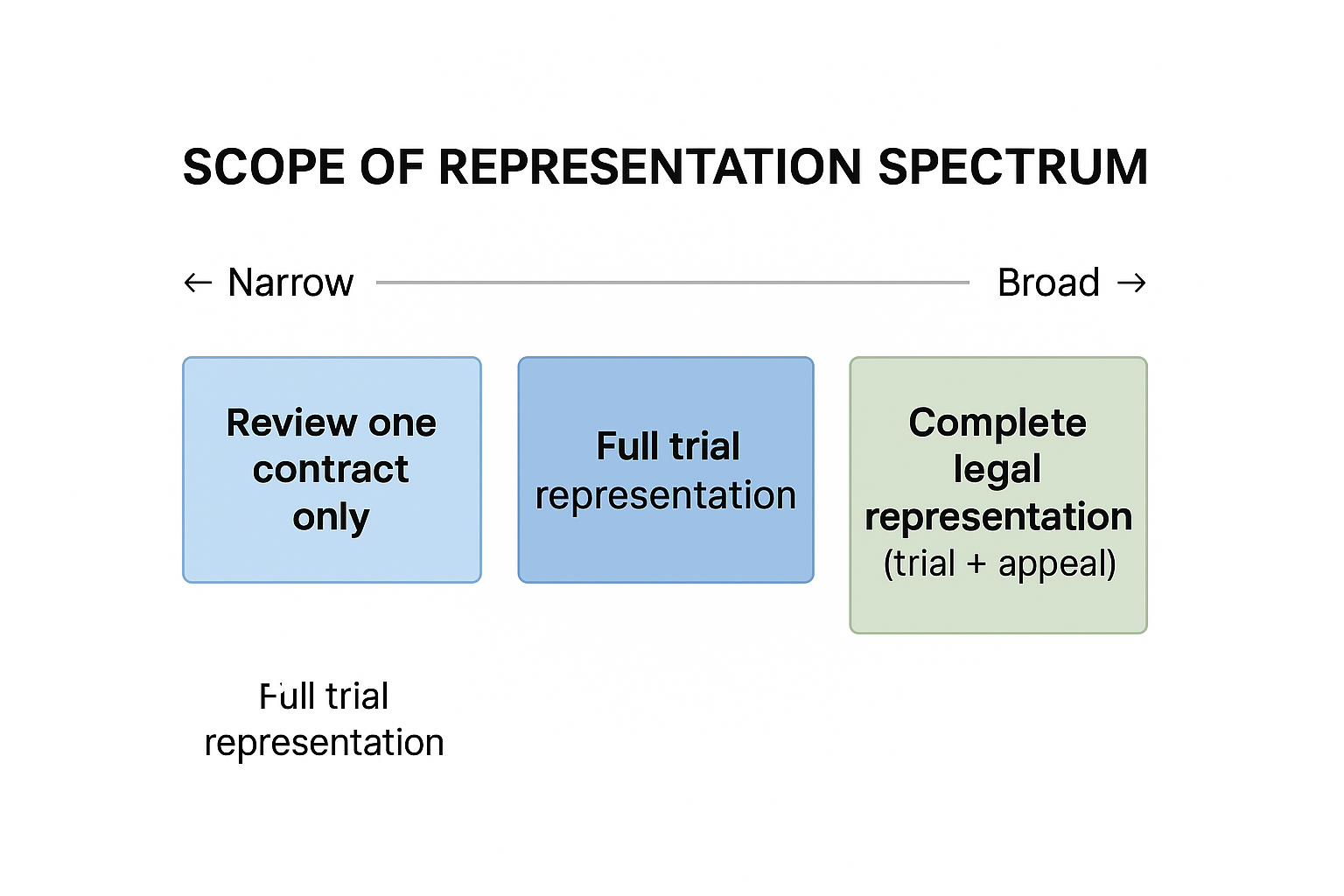
View original ASCII
SCOPE OF REPRESENTATION SPECTRUM← Narrow ─────────────────────────── Broad →
📄 Review one 🏛️ Full trial ⚖️ Complete legal contract only representation representation (trial + appeal)
Criminal Cases - Special Rule 🚨
In criminal cases, the lawyer must abide by the client's decisions concerning:
- Whether to plead guilty
- Whether to waive jury trial
- Whether to testify
💡 Memory Device: "Plea, Jury, Testify" - PJT decisions belong to the client!
Allocation of Authority Between Client and Lawyer ⚖️
The law divides decision-making authority between lawyers and clients:
| CLIENT Decides 👤 | LAWYER Decides 🧑⚖️ |
|---|---|
| OBJECTIVES of representation | MEANS to achieve objectives |
| Settlement authority (civil) | Legal strategy and tactics |
| Plea decisions (criminal) | Which witnesses to call |
| Jury trial waiver (criminal) | Which motions to file |
| Whether to testify (criminal) | Procedural decisions |
| Whether to appeal | Discovery strategy |
Rule 1.2(a): A lawyer shall abide by a client's decisions concerning the objectives of representation and consult with the client about the means.
🔑 Key Principle: Clients control the goals, lawyers control the methods.
Communication Requirements 📞
Lawyers have extensive duties to communicate with clients under Rule 1.4:
Must communicate:
- Promptly inform client of any decision or circumstance requiring informed consent
- Reasonably consult about means to accomplish client's objectives
- Keep client reasonably informed about status of matter
- Promptly comply with reasonable requests for information
- Explain matters to extent reasonably necessary for client to make informed decisions
💡 Tip: Return client phone calls! Failure to communicate is one of the most common ethics complaints.
🚨 Red Flag Situations - Communicate Immediately!
- Settlement offers received
- Court deadlines approaching
- Adverse rulings or developments
- Conflicts of interest that arise
- Need for client decisions
Fees and Fee Agreements 💰
General Fee Requirements
Rule 1.5(a): A lawyer's fee must be reasonable.
Factors for reasonableness:
- Time and labor required
- Novelty and difficulty of questions
- Skill required to perform services
- Fees customarily charged in the locality
- Amount involved and results obtained
- Time limitations imposed
- Lawyer's experience, reputation, and ability
⚠️ Critical Rule: Fee agreements should be in writing (required in some states, strongly recommended everywhere).
Types of Fee Arrangements 📊
| Fee Type | Description | Special Rules |
|---|---|---|
| Hourly Rate | Client pays per hour worked | Must keep accurate time records |
| Flat Fee | Fixed amount for specific service | Common for routine matters |
| Contingency Fee | Percentage of recovery | MUST be in writing; prohibited in criminal and domestic cases |
| Retainer | Advance payment held in trust | Must be in client trust account; refund unused portion |
Contingency Fees - Special Rules 📝
Contingency fees are prohibited in:
- Criminal cases (always prohibited)
- Domestic relations cases where payment is contingent on securing divorce or amount of alimony/support
Rule 1.5(c): Contingency fee agreements MUST be in writing and must state:
- Method by which fee is determined
- Litigation and other expenses to be deducted from recovery
- Whether expenses are deducted before or after calculating contingency percentage
- What percentage lawyer gets (if any) if matter settled, tried, or appealed
Upon conclusion: Must provide written statement showing:
- Outcome
- Remittance to client
- Method of determining fee
💡 Memory Device: "Criminal and Custody" - no Contingency fees!
Fee Splitting 🔀
Rule 1.5(e): Lawyers may divide fees with other lawyers outside their firm ONLY if:
- Division is proportional to services performed OR each lawyer assumes joint responsibility
- Client agrees in writing to the arrangement
- Total fee is reasonable
⚠️ Major Rule: Lawyers may NEVER share legal fees with non-lawyers (with limited exceptions for death benefits, retirement plans, etc.).
Clients with Diminished Capacity 🧠
Rule 1.14 addresses representing clients who have diminished capacity due to:
- Minority (being under 18)
- Mental impairment
- Other reasons affecting ability to make decisions
Lawyer's duties:
- Maintain normal relationship as far as reasonably possible
- May seek appointment of guardian if necessary to protect client
- May reveal confidential information only when needed to protect client from substantial harm
Key principle: Just because someone has diminished capacity doesn't mean they can't make any decisions. Treat them with dignity and respect their autonomy to the extent possible.
REPRESENTING CLIENT WITH DIMINISHED CAPACITY

         Client with diminished capacity
                    |
                    ↓
         Can client communicate wishes?
                    |
           ┌────────┴────────┐
           ↓                 ↓
         YES               NO/LIMITED
           |                 |
           ↓                 ↓
    Maintain normal    Consult with family,
    relationship       guardian if needed
           |                 |
           └────────┬────────┘
                    ↓
         Is client at risk of harm?
                    |
           ┌────────┴────────┐
           ↓                 ↓
         YES               NO
           |                 |
           ↓                 ↓
    May seek guardian   Continue normal
    May reveal info     representation
💡 Tip: When in doubt, err on the side of protecting the client's autonomy unless there's a serious risk of harm.
Organization as Client 🏢
Rule 1.13: When a lawyer represents an organization (corporation, partnership, etc.):
- The organization itself is the client, NOT the individual officers, directors, or employees
- Lawyer must explain this to organizational constituents when interests diverge
Reporting "Up the Ladder" 🪜
If a lawyer knows that an officer or employee is violating law in a way that could harm the organization, the lawyer:
MUST:
- Report to higher authority in organization ("up the ladder")
- If highest authority fails to address, may report "out" to prevent substantial financial harm

View original ASCII
UP-THE-LADDER REPORTINGDiscovery of wrongdoing by employee ↓ Report to supervisor ↓ No action taken? ↓ Report to CEO/Board ↓ Still no action? ↓ Organization will suffer substantial financial injury? ↓ May reveal to prevent harm (permissive, not mandatory)</pre>
Important distinction:
- Lawyer for organization ≠ Personal lawyer for officers
- Must clarify role when interests conflict
- May need to advise individuals to get separate counsel
Termination of Representation 🚪
The attorney-client relationship can end in several ways:
Mandatory Withdrawal ⛔
Rule 1.16(a): A lawyer MUST withdraw if:
- Representation will result in violation of ethics rules or law
- Lawyer's physical or mental condition materially impairs ability to represent client
- Lawyer is discharged by client
💡 Key: Client can always fire the lawyer (though may still owe fees).
Permissive Withdrawal ✅
Rule 1.16(b): A lawyer MAY withdraw if:
- Withdrawal can be accomplished without material adverse effect on client's interests
- Client persists in course of action involving lawyer's services that lawyer reasonably believes is criminal or fraudulent
- Client has used lawyer's services to perpetrate crime or fraud
- Client insists on taking action lawyer finds repugnant or imprudent
- Client fails substantially to fulfill obligation to lawyer (e.g., doesn't pay fees)
- Representation will result in unreasonable financial burden on lawyer
- Other good cause for withdrawal exists
| Mandatory Withdrawal ⛔ | Permissive Withdrawal ✅ |
|---|---|
| Would violate ethics rules | No material adverse effect on client |
| Lawyer physically/mentally impaired | Client used services for crime/fraud |
| Client fires lawyer | Client won't pay fees |
| Client insists on repugnant action | |
| Unreasonable financial burden |
Court Permission Required 🏛️
If a lawyer has been appointed by a court or representation is ongoing in litigation:
- Lawyer generally needs court permission to withdraw
- Must continue representation unless court grants motion to withdraw
- Cannot simply abandon client
⚠️ Critical: Upon termination, lawyer must:
- Give reasonable notice to client
- Allow time for employment of other counsel
- Surrender papers and property to which client is entitled
- Refund any unearned fees
Examples with Explanations 📖
Example 1: Formation of Relationship
Scenario: At a holiday party, Sarah tells Attorney Bob about her landlord dispute. Bob says, "That's interesting. Here's what I think you should do..." and gives detailed advice. Sarah follows the advice, which turns out to be wrong. Has an attorney-client relationship formed?
Analysis: Probably YES. Even though:
- No written agreement existed
- No fee was discussed
- Setting was informal (party)
Sarah could reasonably believe:
- She was seeking legal advice (not just casual conversation)
- Bob was providing professional legal counsel
- She could rely on his advice
Lesson: Be careful about giving legal advice in social settings! Make clear when you're NOT acting as someone's lawyer.
💡 Better response: "I'd need to know more details and review this properly. If you'd like to hire me, call my office and we'll set up a consultation."
Example 2: Contingency Fee Problem
Scenario: Attorney Jane represents Client Tom in a bitter divorce. Tom wants to pay Jane a contingency fee: 30% of any alimony he avoids paying his wife. Can Jane accept this arrangement?
Analysis: NO. This violates Rule 1.5:
- Contingency fees are prohibited in domestic relations cases where payment is contingent on:
- Securing a divorce
- Amount of alimony or support
Why this rule? Policy concerns:
- Encourages settlement and reconciliation
- Prevents financial incentives that could harm family relationships
- Protects vulnerable parties
Permitted alternative: Jane can charge hourly fees or flat fee, but not percentage of financial outcome.
Example 3: Organization as Client
Scenario: Attorney Luis represents XYZ Corporation. The CEO tells Luis in confidence that she's been embezzling company funds. What should Luis do?
Analysis:
- Client is XYZ Corp, not the CEO
- CEO's embezzlement harms the organization (Luis's actual client)
- Luis must report "up the ladder" to the Board of Directors
- Luis should explain to CEO that XYZ is the client, not her personally
- Luis should advise CEO to get her own lawyer
If Board does nothing: Luis may reveal the information outside the organization to prevent substantial financial injury to XYZ.
Key principle: When representing organization, loyalty is to the entity, not individual officers.
🎯 Decision Tree: Who Is My Client?
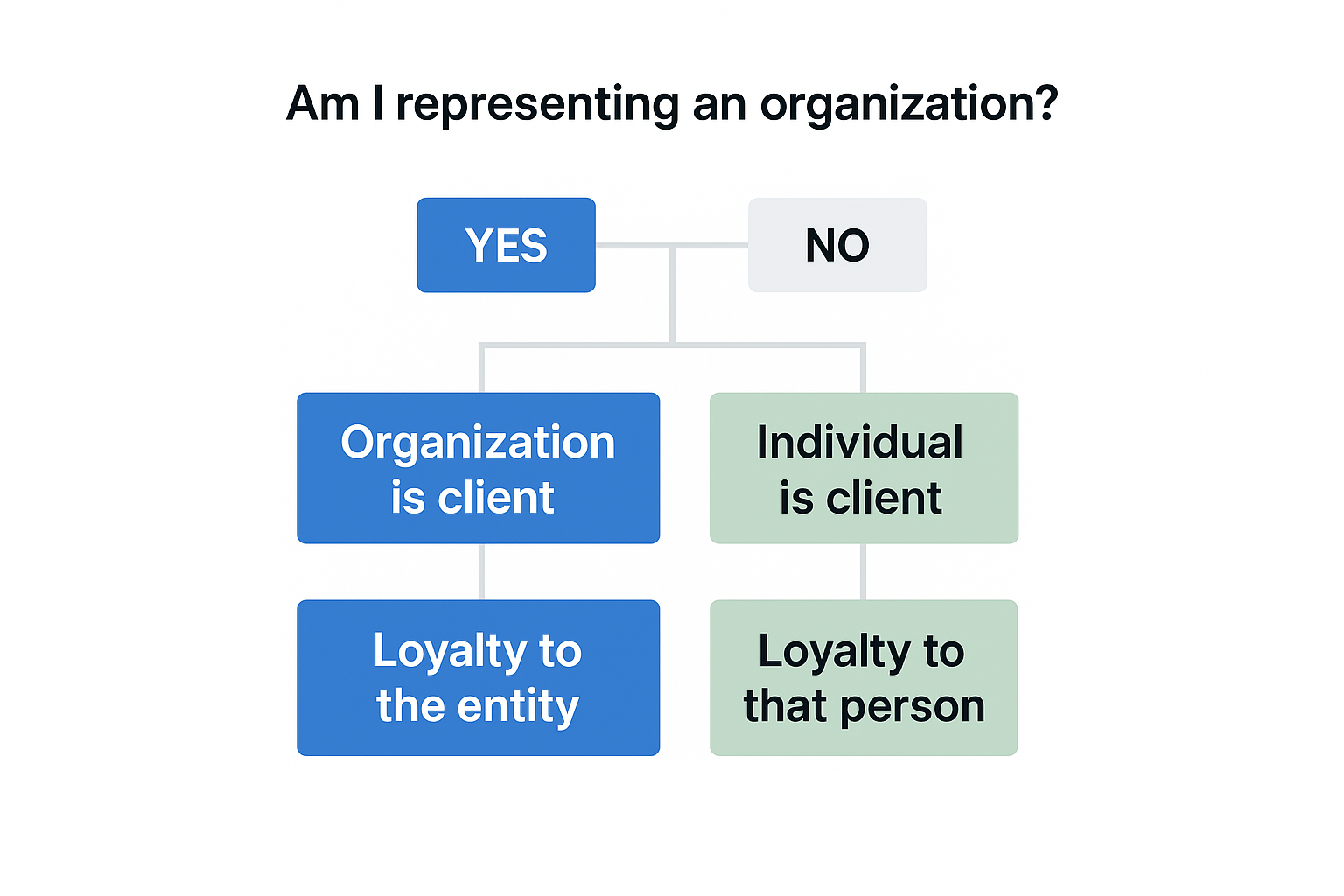
View original ASCII
Am I representing an organization?
         |
    ┌────┴────┐
    ↓         ↓
  YES        NO
    |         |
    ↓         ↓
Organization  Individual
is client     is client
    |         |
    ↓         ↓
Loyalty to   Loyalty to
the entity   that person
Example 4: Withdrawal Dilemma
Scenario: Attorney Maria represents Client Dave in a personal injury lawsuit. Trial is in 2 weeks. Dave stops returning Maria's calls and hasn't paid his bill in 6 months. Can Maria withdraw?
Analysis:
- Permissive withdrawal ground exists: Client hasn't paid fees (Rule 1.16(b)(5))
- BUT: Withdrawal would have material adverse effect on client (trial is imminent)
- AND: Maria likely needs court permission to withdraw from pending litigation
Conclusion: Maria probably cannot withdraw right now without court approval. She should:
- File motion to withdraw with court
- Show good cause (non-payment)
- Demonstrate she's taken steps to protect client's interests
- Continue representation unless court grants withdrawal
Lesson: Timing matters! Easier to withdraw early in representation than right before trial.
Common Mistakes ⚠️
Mistake #1: Assuming Written Agreement Required
❌ Wrong: "I don't have a signed retainer agreement, so no attorney-client relationship exists."
✅ Right: Attorney-client relationships can form through conduct. If someone reasonably believes you're their lawyer and acts on your advice, you may have a relationship (and duties!) even without paperwork.
Mistake #2: Confusing Mandatory vs. Permissive Withdrawal
❌ Wrong: "My client won't pay me, so I must withdraw immediately."
✅ Right: Non-payment is grounds for permissive withdrawal, not mandatory. You can withdraw if it won't materially harm the client, but you're not required to. If withdrawal would harm client (e.g., right before trial), you may need to continue.
Mistake #3: Charging Prohibited Contingency Fees
❌ Wrong: "I'll take 40% of the criminal fine you avoid if I get you acquitted."
✅ Right: Contingency fees are always prohibited in criminal cases. Also prohibited in domestic cases contingent on divorce or support/alimony amounts.
Mistake #4: Thinking You Represent Individual Officers
❌ Wrong: "I represent XYZ Corp, so the CEO is my client and I owe him confidentiality."
✅ Right: The organization is the client, not individual officers. When interests conflict, you must clarify this and may need to report officer's wrongdoing to the board.
Mistake #5: Failing to Communicate
❌ Wrong: "I'm too busy to return every client call. They can wait."
✅ Right: Duty to communicate is not optional. Must keep clients reasonably informed, respond to reasonable requests, and explain matters adequately. Failure to communicate is one of the top ethics complaints.
Mistake #6: Not Getting Informed Consent for Fee Splitting
❌ Wrong: "My co-counsel and I agreed to split fees 50/50. We don't need to tell the client about our internal arrangement."
✅ Right: Fee divisions between lawyers require client's written informed consent. Client has right to know how fees are being divided and by whom.
Key Takeaways 🎯
📋 Quick Reference Card
Formation
- Intent + Consent + Reasonable Reliance
- No writing required
- Duty of confidentiality to prospective clients
Authority Allocation
- Client = OBJECTIVES (goals, settlement, plea)
- Lawyer = MEANS (strategy, tactics)
- Criminal: Client decides plea, jury waiver, testifying
Fees
- Must be reasonable
- Contingency = WRITTEN ONLY
- NO contingency in criminal or domestic (divorce/alimony) cases
- Fee splitting needs client's written consent
Communication
- Keep client reasonably informed
- Respond promptly to requests
- Explain enough for informed decisions
Organization Client
- Entity is client, not officers
- Report wrongdoing "up the ladder"
- May reveal out to prevent substantial financial harm
Withdrawal
- MANDATORY: violation of rules, impairment, fired
- PERMISSIVE: no adverse effect, crime/fraud, non-payment
- Need court permission if litigation pending
- Return papers, refund unearned fees
Memory Devices 🧠
For criminal client decisions (PJT):
- Plea
- Jury waiver
- Testifying
For prohibited contingency fees (CC):
- Criminal cases
- Custody/domestic cases (divorce, alimony, support)
For mandatory withdrawal (VIF):
- Violation of rules/law
- Impairment (physical/mental)
- Fired by client
📚 Further Study
For more information on the client-lawyer relationship:
ABA Model Rules of Professional Conduct - Rules 1.2, 1.4, 1.5, 1.13, 1.14, 1.16, and 1.18: https://www.americanbar.org/groups/professional_responsibility/publications/model_rules_of_professional_conduct/model_rules_of_professional_conduct_table_of_contents/
NCBE MPRE Subject Matter Outline - Official exam outline: https://www.ncbex.org/exams/mpre/
ABA Center for Professional Responsibility - Ethics opinions and resources: https://www.americanbar.org/groups/professional_responsibility/
Good luck with your MPRE preparation! Understanding the client-lawyer relationship is fundamental to professional responsibility and will serve you throughout your legal career. ⚖️✨