Lesson 1: LPN/LVN Scope of Practice & Basic Delegation
Introduction to the practical/vocational nurse role, what LPNs/LVNs can and cannot do, and fundamental delegation principles
SPACED REPETITION · 33 practice questions
Make this lesson stick.
Answer questions, get feedback, and build your review pool. Correct answers move toward longer review intervals; missed answers return sooner.
Sign in to practice →🏥 Lesson 1: LPN/LVN Scope of Practice & Basic Delegation
Introduction
Welcome to your NCLEX-PN preparation journey! As you prepare to become a Licensed Practical Nurse (LPN) or Licensed Vocational Nurse (LVN), understanding your scope of practice is absolutely critical. This lesson focuses on what you CAN do, what you CANNOT do, and how to safely work within your role.
💡 Why this matters: The NCLEX-PN heavily tests your understanding of delegation and prioritization. You'll see many questions asking "What can the LPN do?" or "Which task can be delegated to the UAP?"
🎯 Learning Objectives:
- Identify the LPN/LVN scope of practice
- Understand what tasks LPNs can and cannot perform
- Learn basic delegation principles
- Recognize the difference between LPN, RN, and UAP roles
Core Concepts
What is an LPN/LVN? 🩺
A Licensed Practical Nurse (LPN) or Licensed Vocational Nurse (LVN) provides basic nursing care under the supervision of a Registered Nurse (RN) or physician. You are a vital member of the healthcare team!
Key characteristics of the LPN/LVN role:
- Works under supervision (RN, physician, or other licensed provider)
- Provides direct patient care
- Collects data and reports findings
- Implements care plans created by RNs
- Focuses on patients with stable, predictable conditions
🧠 Memory Tip: The "Stable" Rule
Think: LPNs care for STABLE patients. When a patient becomes unstable or unpredictable, the RN must take over!
What CAN LPNs/LVNs Do? ✅
Let's start with what's IN your scope of practice:
Basic Nursing Care:
- ✅ Take vital signs (temperature, pulse, respirations, blood pressure)
- ✅ Perform physical assessments and collect data
- ✅ Administer medications (oral, IM, subcutaneous, some IV in certain states)
- ✅ Change dressings and provide wound care
- ✅ Insert and maintain urinary catheters
- ✅ Insert nasogastric (NG) tubes
- ✅ Provide basic hygiene care
- ✅ Reinforce patient teaching (after RN does initial teaching)
- ✅ Document care provided
- ✅ Monitor IV infusions (in most states)
Patient Monitoring:
- ✅ Monitor patient responses to treatments
- ✅ Report changes in patient condition to RN
- ✅ Collect specimens (urine, stool, sputum)
- ✅ Perform glucose monitoring
💡 Important Note: State regulations vary! Some states allow LPNs to start IVs or administer IV push medications, while others don't. Always know YOUR state's nurse practice act!
What CANNOT LPNs/LVNs Do? ❌
This is critical for the NCLEX-PN! Know your limitations:
Assessment & Planning:
- ❌ Perform initial nursing assessment (you can collect data, but RN does assessment)
- ❌ Create nursing care plans (RN role)
- ❌ Develop patient teaching plans (you can reinforce, not develop)
Complex Procedures:
- ❌ Administer IV push medications (in most states)
- ❌ Administer blood products (in most states)
- ❌ Give medications through central lines (PICC, central venous catheters)
- ❌ Perform initial patient teaching
- ❌ Interpret assessment findings independently
Unstable Patients:
- ❌ Care for unstable or rapidly changing patients
- ❌ Care for patients requiring complex assessments
- ❌ Perform triage in emergency situations
┌─────────────────────────────────────────────────┐
│         LPN/LVN ROLE VISUALIZATION              │
└─────────────────────────────────────────────────┘

        RN Creates Plan
              │
              ↓
        ┌──────────────┐
        │ Nursing Care │
        │     Plan     │
        └──────────────┘
              │
              ↓
    LPN Implements Plan
              │
      ┌───────┼───────┐
      ↓       ↓       ↓
   Meds   Wound   Vital
          Care    Signs
      │       │       │
      └───────┼───────┘
              ↓
    LPN Reports to RN
              │
              ↓
     RN Evaluates & Updates Plan
Understanding Delegation 👥
Delegation means transferring the authority to perform a task to another person while retaining accountability. On the NCLEX-PN, you'll need to understand:
- Who can delegate TO you (RN, physician)
- Who YOU can delegate to (Unlicensed Assistive Personnel/UAP)
The Five Rights of Delegation (memorize these!):
| Right | Meaning | Example Question to Ask |
|---|---|---|
| 🎯 Right Task | Is this task appropriate to delegate? | "Is this within the UAP's scope?" |
| 🎯 Right Circumstance | Is the patient stable enough? | "Is this patient's condition predictable?" |
| 🎯 Right Person | Does this person have the skills? | "Has this UAP been trained for this?" |
| 🎯 Right Direction | Have you given clear instructions? | "Did I explain exactly what to do?" |
| 🎯 Right Supervision | Will you follow up appropriately? | "How will I monitor the outcome?" |
🧠 Mnemonic: "TPCDS" - Task, Person, Circumstance, Direction, Supervision (or remember "The Pretty Cat Drinks Slowly")
Tasks You CAN Delegate to UAP 📋
As an LPN, you may supervise Unlicensed Assistive Personnel (UAP) like nursing assistants or patient care techs. You can delegate:
✅ Activities of Daily Living (ADLs):
- Bathing
- Feeding (stable patients)
- Dressing
- Toileting
- Ambulation (stable patients)
- Repositioning
✅ Basic care tasks:
- Taking vital signs on stable patients
- Measuring intake and output
- Specimen collection (urine, stool)
- Making beds
- Basic hygiene
Tasks You CANNOT Delegate to UAP ❌
Never delegate anything requiring:
- ❌ Nursing judgment
- ❌ Assessment skills
- ❌ Medication administration
- ❌ Patient teaching
- ❌ Sterile procedures
- ❌ Care of unstable patients
⚠️ Critical Safety Point
YOU remain accountable for tasks you delegate! If you delegate something and the UAP does it incorrectly, you share responsibility. Always supervise and follow up!
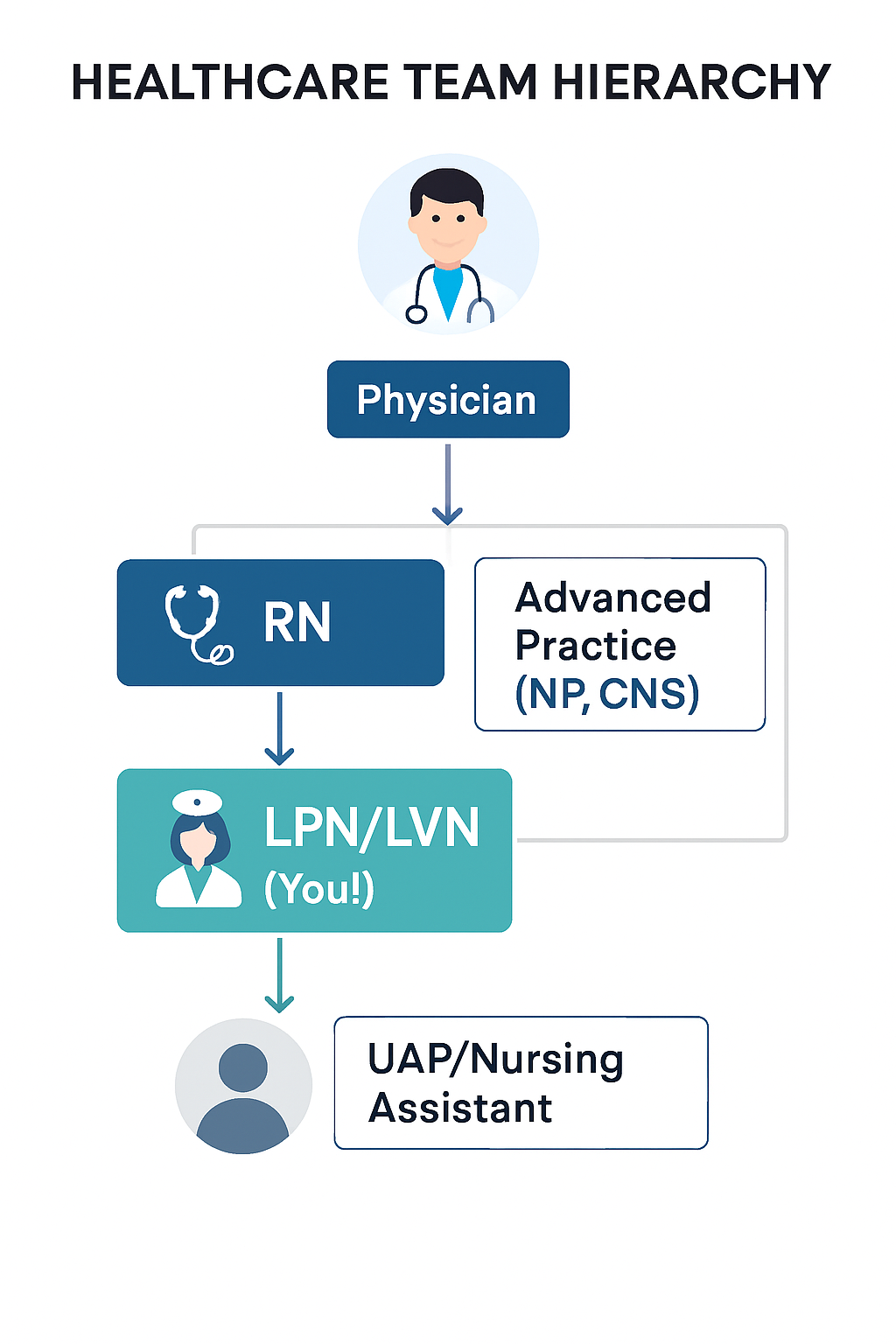
The Healthcare Team Hierarchy 🏥
Understanding where you fit in the team is essential:
View original ASCII
HEALTHCARE TEAM HIERARCHY👨⚕️ Physician │ ↓ ┌─────────────────────┐ │ │ ↓ ↓ 🩺 RN (Registered) Advanced Practice Nurse (NP, CNS) │ ↓ 👩⚕️ LPN/LVN (You!) │ ↓ 👤 UAP/Nursing Assistant</pre>
Key relationships:
- RN → LPN: RN supervises LPN, creates care plans, handles complex/unstable patients
- LPN → UAP: LPN can supervise UAP for delegated tasks
- LPN → RN: LPN reports patient data and changes to RN
Detailed Examples 📖
Let's apply these concepts to realistic scenarios you'll see on the NCLEX-PN:
Example 1: Delegation Decision 🤔
Scenario: You are an LPN working on a medical-surgical unit. You have four tasks to complete this morning:
- Give oral medications to a patient with stable diabetes
- Assess a new postoperative patient just admitted from recovery
- Help a patient with breakfast
- Change a simple dry dressing on a healing surgical wound
Question: Which task MUST be performed by the RN?
Answer: B - Assessing a new postoperative patient
Explanation:
- Task A (medications): ✅ Within LPN scope for stable patient
- Task B (initial assessment): ❌ ONLY RN can do initial assessments, especially post-op
- Task C (feeding): ✅ Can be delegated to UAP
- Task D (dressing change): ✅ Within LPN scope
💡 Key Learning: Remember the word "INITIAL"! Initial assessments, initial teaching, initial care plans = RN only!
Example 2: Safe Delegation to UAP 👥
Scenario: You're caring for four patients and need to delegate some tasks to the UAP on your team:
Patient A: 85-year-old with stable heart failure, needs vital signs and assistance with bath Patient B: 45-year-old post-appendectomy (Day 1), needs ambulation in hallway Patient C: 60-year-old with uncontrolled diabetes, blood sugar was 350 this morning Patient D: 72-year-old with COPD, needs respiratory assessment
Question: Which patient care can you safely delegate to the UAP?
Answer: Patient A - vital signs and bath assistance
Explanation:
- Patient A: ✅ Stable condition, ADLs (bathing) appropriate for UAP
- Patient B: ⚠️ Post-op Day 1 = potentially unstable, LPN should ambulate and assess
- Patient C: ❌ Uncontrolled diabetes = unstable, needs nursing judgment
- Patient D: ❌ Respiratory assessment requires nursing judgment (cannot delegate assessment)
💡 Key Learning: The word "stable" is your clue! Stable + basic care = safe to delegate.
Example 3: Scope of Practice Boundary 🚧
Scenario: The RN asks you to perform the following tasks. Which one is OUTSIDE your LPN scope of practice?
- Reinforce discharge teaching about wound care that the RN taught yesterday
- Insert a urinary catheter for a patient with urinary retention
- Develop a teaching plan for a newly diagnosed diabetic patient
- Administer insulin subcutaneously to a stable diabetic patient
Answer: C - Develop a teaching plan
Explanation:
- Task A (reinforce teaching): ✅ LPNs can REINFORCE what RN already taught
- Task B (catheter insertion): ✅ Within LPN scope
- Task C (develop teaching plan): ❌ DEVELOPING plans = RN role; LPNs implement
- Task D (administer insulin): ✅ Within LPN scope for stable patient
💡 Key Learning: "Develop," "create," "formulate" = RN words. "Implement," "reinforce," "assist" = LPN words!
Example 4: Priority and Delegation Combined ⚡
Scenario: You're working the evening shift with one UAP. You receive report on these patients:
- Mr. Jones: Stable CHF, needs 6 PM medications
- Mrs. Smith: Post-stroke Day 3, needs help with dinner
- Mr. Brown: New complaint of chest pain
- Ms. Garcia: Needs routine vital signs
Question: What should you do FIRST, and what can you delegate?
Answer:
- First action: Assess Mr. Brown (chest pain = potential emergency)
- Delegate to UAP: Help Mrs. Smith with dinner (stable patient, ADL)
- Do yourself after chest pain: Give Mr. Jones medications
- Delegate or do later: Ms. Garcia vital signs (routine, not urgent)
Explanation: This scenario combines prioritization (ABCs - airway, breathing, circulation) with delegation:
- Chest pain is life-threatening → assess immediately
- Feeding stable patient → safe for UAP
- Medications → important but not life-threatening
- Routine vital signs → lowest priority
💡 Key Learning: Always use ABCs (Airway, Breathing, Circulation) to prioritize! Life-threatening situations come first.
🧠 Priority Memory Tool: "ABC-MAAS"
| Airway | Cannot breathe = cannot live |
| Breathing | Respiratory problems |
| Circulation | Cardiac/bleeding issues |
| Mental status | Changes in consciousness |
| Acute pain | Sudden severe pain |
| Actual problems | Before potential problems |
| Stable last | Stable patients = lowest priority |
Common Mistakes ⚠️
Mistake 1: Confusing "Data Collection" with "Assessment"
❌ Wrong thinking: "I collected vital signs and breath sounds, so I did an assessment."
✅ Correct thinking: "I collected DATA (vital signs, breath sounds). The RN will ASSESS what this data means and update the care plan."
Why it matters: Assessment involves analyzing and interpreting data to make nursing diagnoses. LPNs collect data; RNs assess.
Mistake 2: Delegating Tasks Requiring Judgment
❌ Wrong: "The patient is stable, so I'll have the UAP give the morning medications."
✅ Correct: "I'll give the medications myself. Even for stable patients, medication administration requires nursing judgment."
Why it matters: Medication administration ALWAYS requires assessment of the patient's ability to take meds safely - this needs a licensed nurse.
Mistake 3: Accepting Tasks Outside Your Scope
❌ Wrong: "The RN is busy, so I'll go ahead and assess that new admission."
✅ Correct: "Initial assessments are outside my scope. I'll let the RN know the patient needs assessment and I can help with other tasks."
Why it matters: Working outside your scope puts your license at risk AND puts patients in danger. Always stay within your boundaries!
Mistake 4: Not Supervising Delegated Tasks
❌ Wrong: "I delegated the bath to the UAP, so that's done."
✅ Correct: "I delegated the bath to the UAP. I'll check on them halfway through and verify completion afterward. I'm still accountable!"
Why it matters: Delegation doesn't mean dumping tasks. You remain responsible for ensuring the task is done correctly.
Mistake 5: Thinking "Stable" Means "No Changes"
❌ Wrong: "This patient was stable yesterday, so they're stable today. The UAP can handle everything."
✅ Correct: "Even stable patients need nursing assessment each shift. I'll check the patient myself before delegating routine care."
Why it matters: Patient conditions change! What was stable yesterday might not be stable today. Always verify before delegating.
⚠️ NCLEX-PN Test Tip
When you see "Which task can the LPN delegate?" look for:
- ✅ Stable patient conditions
- ✅ ADLs (activities of daily living)
- ✅ Tasks with no nursing judgment needed
- ❌ Avoid: assessment, teaching, medications, unstable patients
Key Takeaways 🎯
Let's summarize the most important concepts from this lesson:
1️⃣ LPN/LVN Scope Basics
- Work under RN/physician supervision
- Care for stable, predictable patients
- Implement care plans (not create them)
- Collect data (not perform assessments)
- Reinforce teaching (not develop teaching plans)
2️⃣ The "Cannot" List (Memorize This!)
- ❌ Initial assessments
- ❌ Create care plans
- ❌ Develop teaching plans
- ❌ Care for unstable patients
- ❌ Give IV push meds (most states)
- ❌ Administer blood products (most states)
3️⃣ Delegation Essentials
- Use the Five Rights of Delegation
- Delegate ADLs and basic care to UAP
- NEVER delegate: assessment, teaching, medications, sterile procedures
- You remain accountable for delegated tasks
4️⃣ Priority Framework
- ABC = Airway, Breathing, Circulation (always first!)
- Life-threatening before non-life-threatening
- Actual problems before potential problems
- Unstable before stable
5️⃣ Key Words to Recognize
RN-only words: Initial, assess, develop, create, formulate, evaluate, unstable, complex
LPN-appropriate words: Implement, reinforce, assist, collect data, monitor, stable, routine
UAP-appropriate words: ADLs, basic care, stable, routine, assistance
📋 Quick Reference Card: LPN Scope at a Glance
| Category | ✅ LPN CAN Do | ❌ LPN CANNOT Do |
|---|---|---|
| Assessment | Collect data, take vital signs | Initial assessments, nursing diagnosis |
| Planning | Contribute to care plan | Create/develop care plans |
| Implementation | Give meds, wound care, insert catheters | IV push (most states), blood products |
| Teaching | Reinforce existing teaching | Initial teaching, develop teaching plans |
| Patients | Stable, predictable conditions | Unstable, complex, rapidly changing |
| Delegation | ADLs to UAP, basic care tasks | Assessment, meds, teaching, judgment |
📚 Further Study
To deepen your understanding of LPN/LVN scope of practice and delegation:
National Council of State Boards of Nursing (NCSBN) - Official NCLEX-PN test plan and scope of practice guidelines: https://www.ncsbn.org/nclex-pn-exam.htm
American Association of Colleges of Nursing (AACN) - Delegation resources and nursing roles: https://www.aacnnursing.org/
Your State Board of Nursing - Always check your specific state's nurse practice act, as regulations vary by state. Find yours at: https://www.ncsbn.org/contact-bon.htm
🔧 Try This: Self-Check Exercise
Before moving to the practice questions, test yourself:
- List 3 things you CAN do as an LPN
- List 3 things you CANNOT do as an LPN
- Name one task you can delegate to UAP
- Name one task you cannot delegate to UAP
- What does "stable patient" mean to you?
If you can answer these confidently, you're ready for the practice questions! If not, review the core concepts section again.
🎉 Congratulations! You've completed Lesson 1 on LPN/LVN Scope of Practice and Basic Delegation. Understanding these concepts is your foundation for NCLEX-PN success. Remember: when in doubt about your scope, ask yourself "Is this patient stable? Does this require nursing judgment? Am I qualified to do this?" These three questions will guide you through most delegation and scope decisions.
Now let's practice with questions that will prepare you for the real exam! 💪